Pimiento: Difference between revisions
CSV import Tags: mobile edit mobile web edit |
CSV import |
||
| Line 25: | Line 25: | ||
{{stub}} | {{stub}} | ||
{{dictionary-stub1}} | {{dictionary-stub1}} | ||
<gallery> | |||
File:Cherry_peppers.jpg|Pimiento | |||
File:Cherrypeppers.jpg|Pimiento | |||
File:GreenOlives_largejar.jpg|Pimiento | |||
</gallery> | |||
Latest revision as of 01:57, 18 February 2025
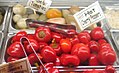
Pimiento or pimento is a type of pepper that is large, red, heart-shaped, and sweet. It is also known as a cherry pepper due to its red color and round shape. Pimientos are native to North America and are also grown in the Mediterranean region. They are commonly used in cooking, especially in Spanish cuisine and Southern United States cuisine.
Description[edit]
Pimientos are a variety of large, red, heart-shaped chili pepper (Capsicum annuum) that measures 3 to 4 inches long and 2 to 3 inches wide. The flesh of the pimiento is sweet, succulent, and more aromatic than that of the red bell pepper. Some varieties of the pimiento type are hot, including the Floral Gem and Santa Fe Grande varieties.
Cultivation[edit]
Pimientos are typically grown in the United States, Spain, and Portugal. They require a warm climate for optimal growth. The plants are usually started indoors and then transplanted outside after the last frost. Pimientos are harvested when they reach full size and their color changes from green to a deep, vibrant red.
Uses[edit]
Pimientos are often used in cooking in both their fresh and dried forms. They can be roasted, stuffed, or used as a flavoring in a variety of dishes. Pimientos are also used to make pimento cheese, a popular spread in the Southern United States, and pimento-stuffed olives. In Spain, pimientos are often fried in olive oil and served as a side dish.
Nutritional Value[edit]
Pimientos are rich in vitamin C and vitamin A, and also contain significant amounts of vitamin B6, vitamin E, and vitamin K. They are also a good source of dietary fiber.
See Also[edit]
 | |
|---|---|
 |
 |
| This medical article is a stub. You can help Wikipedia by adding missing information. |
-
 Pimiento
 -
 Pimiento
 -
 Pimiento


