Southeast Asian haze: Difference between revisions
CSV import Tags: mobile edit mobile web edit |
CSV import |
||
| Line 25: | Line 25: | ||
{{Health in Southeast Asia}} | {{Health in Southeast Asia}} | ||
{{food-stub}} | {{food-stub}} | ||
<gallery> | |||
File:Peat_fire_in_Selangor,_Malaysia_on_5_June_2013.JPG|Peat fire in Selangor, Malaysia on 5 June 2013 | |||
File:A_peat_swamp_forest_in_Selangor,_Malaysia.JPG|A peat swamp forest in Selangor, Malaysia | |||
</gallery> | |||
Latest revision as of 01:09, 18 February 2025
Southeast Asian haze is a fire-related large-scale air pollution problem that occurs regularly. These haze events have caused adverse health and economic impact on Brunei, Indonesia, Malaysia, Singapore, and Thailand. The problem flares up every dry season, in varying degrees. Transboundary haze occurs when pollution from these fires travels across boundaries, affecting neighboring countries.
Causes[edit]
The primary cause of Southeast Asian haze is the illegal burning of vegetation for palm oil, pulp and paper industries in Kalimantan and Sumatra. These fires can be caused by a process called slash-and-burn, where vegetation is cut down and burned to clear land for agriculture.
Effects[edit]
The haze pollution poses serious health and economic problems. It increases the risk of respiratory diseases and can disrupt air travel and other forms of transportation. The economic losses are due to health care costs and business disruptions.
Prevention and Mitigation[edit]
Efforts to prevent and mitigate Southeast Asian haze include law enforcement, regional cooperation, and public awareness campaigns. The ASEAN Agreement on Transboundary Haze Pollution is an international environmental agreement to reduce haze pollution in Southeast Asia.
See also[edit]
References[edit]
<references />
| Air pollution Topics | ||||||||||
|---|---|---|---|---|---|---|---|---|---|---|
This air pollution related article is a stub.
|
| Environmental issues in Southeast Asia |
|---|
|
This environmental issues in Southeast Asia related article is a stub.
|
| Health in Southeast Asia | ||||||||||
|---|---|---|---|---|---|---|---|---|---|---|
This Health in Southeast Asia related article is a stub.
|

-
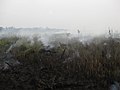 Peat fire in Selangor, Malaysia on 5 June 2013
 -
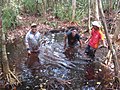 A peat swamp forest in Selangor, Malaysia


