Tunisian cuisine: Difference between revisions
CSV import |
CSV import |
||
| Line 1: | Line 1: | ||
'''Tunisian cuisine''' is | {{short description|Overview of the culinary traditions of Tunisia}} | ||
{{Use dmy dates|date=October 2023}} | |||
'''Tunisian cuisine''' is a blend of [[Mediterranean cuisine|Mediterranean]] and [[Maghreb cuisine|Maghreb]] culinary traditions. It is known for its rich flavors, use of spices, and diverse ingredients. The cuisine reflects the country's history and cultural influences, including [[Berber people|Berber]], [[Arab]], [[Turkish people|Turkish]], and [[French people|French]]. | |||
==History== | ==History== | ||
Tunisian cuisine has evolved over centuries, influenced by the various civilizations that have settled in the region. The [[Phoenicians]] introduced [[olive oil]], while the [[Romans]] brought [[wheat]] and [[barley]]. The [[Arabs]] introduced [[spices]] and [[couscous]], and the [[Ottoman Empire|Ottomans]] contributed [[pastries]] and [[coffee]]. French colonization in the 19th century added new cooking techniques and ingredients. | |||
==Ingredients== | ==Ingredients== | ||
Tunisian cuisine is characterized by its use of [[olive oil]], [[spices]], [[tomatoes]], [[seafood]], and [[lamb]]. Common spices include [[cumin]], [[coriander]], [[caraway]], and [[harissa]], a hot chili pepper paste that is a staple in many dishes. | |||
==Dishes== | ==Dishes== | ||
===Appetizers=== | |||
* '''[[Brik]]''': A thin pastry filled with egg, tuna, or meat, and deep-fried. | |||
* '''[[Salata Mechouia]]''': A grilled salad made with peppers, tomatoes, and onions. | |||
===Main Courses=== | |||
* '''[[Couscous]]''': A staple dish made with steamed semolina grains, often served with meat and vegetables. | |||
* '''[[Ojja]]''': A spicy stew made with tomatoes, peppers, and eggs. | |||
* '''[[Lablabi]]''': A chickpea soup flavored with cumin and garlic, often served with bread. | |||
* '''[[Merguez]]''': Spicy lamb or beef sausages. | |||
===Desserts=== | |||
* '''[[Makroud]]''': A semolina cake filled with dates or almonds and soaked in honey. | |||
* '''[[Baklava]]''': A sweet pastry made of layers of filo filled with nuts and honey. | |||
==Beverages== | ==Beverages== | ||
Tunisian beverages include [[mint tea]], [[Turkish coffee]], and [[boukha]], a distilled spirit made from figs. | |||
== | ==Related pages== | ||
* [[ | * [[Mediterranean cuisine]] | ||
* [[Maghreb cuisine]] | |||
* [[North African cuisine]] | * [[North African cuisine]] | ||
== | ==Gallery== | ||
< | <gallery> | ||
File:Bol_de_Leblabi_de_Tunisie,_21_mars_2017.jpg|Lablabi | |||
File:LocationTunisia.svg|Map of Tunisia | |||
File:Eating_Asida.JPG|Asida | |||
File:Merguez_sausages.jpg|Merguez sausages | |||
File:Shakshoka.jpg|Shakshouka | |||
File:Tunisian_Ojja.jpg|Ojja | |||
File:Couscous_bel_Osban.jpg|Couscous bel Osban | |||
File:Brikdish.jpg|Brik | |||
File:Tabouna_(Piotr_Kuczynski).jpg|Tabouna bread | |||
File:Patisserie_tunisienne.jpg|Tunisian pastries | |||
File:Harissa_Sauce.JPG|Harissa sauce | |||
File:Makrouds.JPG|Makrouds | |||
</gallery> | |||
[[Category:Tunisian cuisine]] | [[Category:Tunisian cuisine]] | ||
[[Category:African cuisine]] | [[Category:North African cuisine]] | ||
Revision as of 00:37, 10 February 2025
Overview of the culinary traditions of Tunisia
Tunisian cuisine is a blend of Mediterranean and Maghreb culinary traditions. It is known for its rich flavors, use of spices, and diverse ingredients. The cuisine reflects the country's history and cultural influences, including Berber, Arab, Turkish, and French.
History
Tunisian cuisine has evolved over centuries, influenced by the various civilizations that have settled in the region. The Phoenicians introduced olive oil, while the Romans brought wheat and barley. The Arabs introduced spices and couscous, and the Ottomans contributed pastries and coffee. French colonization in the 19th century added new cooking techniques and ingredients.
Ingredients
Tunisian cuisine is characterized by its use of olive oil, spices, tomatoes, seafood, and lamb. Common spices include cumin, coriander, caraway, and harissa, a hot chili pepper paste that is a staple in many dishes.
Dishes
Appetizers
- Brik: A thin pastry filled with egg, tuna, or meat, and deep-fried.
- Salata Mechouia: A grilled salad made with peppers, tomatoes, and onions.
Main Courses
- Couscous: A staple dish made with steamed semolina grains, often served with meat and vegetables.
- Ojja: A spicy stew made with tomatoes, peppers, and eggs.
- Lablabi: A chickpea soup flavored with cumin and garlic, often served with bread.
- Merguez: Spicy lamb or beef sausages.
Desserts
- Makroud: A semolina cake filled with dates or almonds and soaked in honey.
- Baklava: A sweet pastry made of layers of filo filled with nuts and honey.
Beverages
Tunisian beverages include mint tea, Turkish coffee, and boukha, a distilled spirit made from figs.
Related pages
Gallery
-
 Lablabi
 -
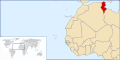 Map of Tunisia
 -
 Asida
Asida -
 Merguez sausages
 -
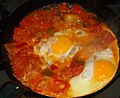 Shakshouka
 -
 Ojja
Ojja -
 Couscous bel Osban
 -
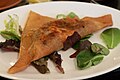 Brik
Brik -
 Tabouna bread
 -
 Tunisian pastries
 -
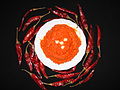 Harissa sauce
 -
 Makrouds


.jpg)


