Pediculosis: Difference between revisions
CSV import |
CSV import Tags: mobile edit mobile web edit |
||
| Line 1: | Line 1: | ||
{{SI}} | |||
{{Infobox medical condition | |||
| name = Pediculosis | |||
| image = [[File:Pediculus_humanus_var_capitis.jpg|250px]] | |||
| caption = ''[[Pediculus humanus capitis]]'', the head louse | |||
| synonyms = Lice infestation | |||
| field = [[Dermatology]] | |||
| symptoms = [[Itching]], visible lice or nits | |||
| complications = [[Secondary bacterial infection]] | |||
| onset = | |||
| duration = | |||
| causes = Infestation by ''[[Pediculus humanus capitis]]'', ''[[Pediculus humanus corporis]]'', or ''[[Pthirus pubis]]'' | |||
| risks = Close contact, sharing personal items | |||
| diagnosis = Visual inspection, use of a fine-toothed comb | |||
| differential = [[Dandruff]], [[seborrheic dermatitis]], [[scabies]] | |||
| prevention = Avoiding head-to-head contact, not sharing personal items | |||
| treatment = Topical insecticides, wet combing | |||
| medication = [[Permethrin]], [[Ivermectin]], [[Malathion]] | |||
| prognosis = Good with treatment | |||
| frequency = Common worldwide | |||
}} | |||
'''Pediculosis''' is a condition caused by infestations of the human louse. It is a common issue worldwide, affecting millions of people each year. There are three types of lice that infest humans: head lice, body lice, and pubic lice. | '''Pediculosis''' is a condition caused by infestations of the human louse. It is a common issue worldwide, affecting millions of people each year. There are three types of lice that infest humans: head lice, body lice, and pubic lice. | ||
==Types of Pediculosis== | ==Types of Pediculosis== | ||
===Head Lice=== | ===Head Lice=== | ||
[[Head lice]] (Pediculus humanus capitis) are the most common type of lice infestation. They are most commonly found in children, but can affect people of all ages. Head lice infestations are not related to personal hygiene. | [[Head lice]] (Pediculus humanus capitis) are the most common type of lice infestation. They are most commonly found in children, but can affect people of all ages. Head lice infestations are not related to personal hygiene. | ||
===Body Lice=== | ===Body Lice=== | ||
[[Body lice]] (Pediculus humanus corporis) are less common than head lice, but can still cause significant discomfort. They are often associated with poor hygiene and living conditions, and can spread diseases such as typhus. | [[Body lice]] (Pediculus humanus corporis) are less common than head lice, but can still cause significant discomfort. They are often associated with poor hygiene and living conditions, and can spread diseases such as typhus. | ||
===Pubic Lice=== | ===Pubic Lice=== | ||
[[Pubic lice]] (Pthirus pubis), also known as crabs, are another type of lice infestation. They are most commonly spread through sexual contact, but can also be spread through sharing bedding or clothing. | [[Pubic lice]] (Pthirus pubis), also known as crabs, are another type of lice infestation. They are most commonly spread through sexual contact, but can also be spread through sharing bedding or clothing. | ||
==Symptoms== | ==Symptoms== | ||
The main symptom of pediculosis is itching, caused by an allergic reaction to louse saliva. Other symptoms can include a rash, sores from scratching, and the presence of lice or nits (lice eggs) in the hair or on the body. | The main symptom of pediculosis is itching, caused by an allergic reaction to louse saliva. Other symptoms can include a rash, sores from scratching, and the presence of lice or nits (lice eggs) in the hair or on the body. | ||
==Treatment== | ==Treatment== | ||
Treatment for pediculosis typically involves the use of over-the-counter or prescription medications that kill lice and their eggs. In some cases, manual removal of lice and nits may be necessary. | Treatment for pediculosis typically involves the use of over-the-counter or prescription medications that kill lice and their eggs. In some cases, manual removal of lice and nits may be necessary. | ||
==Prevention== | ==Prevention== | ||
Prevention of pediculosis involves avoiding close contact with individuals who have lice, not sharing personal items such as hats or hairbrushes, and regular cleaning of bedding and clothing. | Prevention of pediculosis involves avoiding close contact with individuals who have lice, not sharing personal items such as hats or hairbrushes, and regular cleaning of bedding and clothing. | ||
==Gallery== | |||
<gallery> | |||
File:Head louse crawling on hairbrush.webm|Head louse crawling on hairbrush | |||
File:Pediculus humanus capitis 2.jpg|Pediculus humanus capitis | |||
</gallery> | |||
[[Category:Parasitic infestations, stings, and bites of the skin]] | [[Category:Parasitic infestations, stings, and bites of the skin]] | ||
[[Category:Conditions of the skin appendages]] | [[Category:Conditions of the skin appendages]] | ||
[[Category:Infectious diseases]] | [[Category:Infectious diseases]] | ||
{{stub}} | {{stub}} | ||
Latest revision as of 06:21, 6 April 2025

Editor-In-Chief: Prab R Tumpati, MD
Obesity, Sleep & Internal medicine
Founder, WikiMD Wellnesspedia &
W8MD medical weight loss NYC and sleep center NYC
| Pediculosis | |
|---|---|

| |
| Synonyms | Lice infestation |
| Pronounce | N/A |
| Specialty | N/A |
| Symptoms | Itching, visible lice or nits |
| Complications | Secondary bacterial infection |
| Onset | |
| Duration | |
| Types | N/A |
| Causes | Infestation by Pediculus humanus capitis, Pediculus humanus corporis, or Pthirus pubis |
| Risks | Close contact, sharing personal items |
| Diagnosis | Visual inspection, use of a fine-toothed comb |
| Differential diagnosis | Dandruff, seborrheic dermatitis, scabies |
| Prevention | Avoiding head-to-head contact, not sharing personal items |
| Treatment | Topical insecticides, wet combing |
| Medication | Permethrin, Ivermectin, Malathion |
| Prognosis | Good with treatment |
| Frequency | Common worldwide |
| Deaths | N/A |
Pediculosis is a condition caused by infestations of the human louse. It is a common issue worldwide, affecting millions of people each year. There are three types of lice that infest humans: head lice, body lice, and pubic lice.
Types of Pediculosis[edit]
Head Lice[edit]
Head lice (Pediculus humanus capitis) are the most common type of lice infestation. They are most commonly found in children, but can affect people of all ages. Head lice infestations are not related to personal hygiene.
Body Lice[edit]
Body lice (Pediculus humanus corporis) are less common than head lice, but can still cause significant discomfort. They are often associated with poor hygiene and living conditions, and can spread diseases such as typhus.
Pubic Lice[edit]
Pubic lice (Pthirus pubis), also known as crabs, are another type of lice infestation. They are most commonly spread through sexual contact, but can also be spread through sharing bedding or clothing.
Symptoms[edit]
The main symptom of pediculosis is itching, caused by an allergic reaction to louse saliva. Other symptoms can include a rash, sores from scratching, and the presence of lice or nits (lice eggs) in the hair or on the body.
Treatment[edit]
Treatment for pediculosis typically involves the use of over-the-counter or prescription medications that kill lice and their eggs. In some cases, manual removal of lice and nits may be necessary.
Prevention[edit]
Prevention of pediculosis involves avoiding close contact with individuals who have lice, not sharing personal items such as hats or hairbrushes, and regular cleaning of bedding and clothing.
Gallery[edit]
-
 Head louse crawling on hairbrush
 -
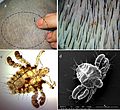 Pediculus humanus capitis


