Freekeh: Difference between revisions
CSV import |
CSV import |
||
| Line 24: | Line 24: | ||
[[Category:Levantine cuisine]] | [[Category:Levantine cuisine]] | ||
{{food-stub}} | {{food-stub}} | ||
== Freekeh == | |||
<gallery> | |||
File:Freekeh_with_roasted_vegetables.jpg|Freekeh with roasted vegetables | |||
File:Firik_ve_bulgur.jpg|Firik ve bulgur | |||
</gallery> | |||
== Freekeh == | == Freekeh == | ||
<gallery> | <gallery> | ||
Revision as of 00:54, 18 February 2025
Freekeh (also known as farik) is a traditional cereal food made from green durum wheat that is roasted and rubbed to create its unique flavor. It is an ancient dish derived from Levantine cuisine, and is still used in Jordan, Lebanon, Syria, and Palestine.
History
The name freekeh is derived from the Arabic word "faraka" which means "to rub", referring to the method by which freekeh is created. The process of making freekeh was reportedly discovered accidentally over 2,000 years ago when a Middle Eastern village's crop of young, green wheat was burnt. The villagers found that they could salvage the crop by rubbing away the burnt outer layer, revealing the roasted grains inside.
Production
The production of freekeh involves harvesting durum wheat while it is still green and soft. The grains are then dried in the sun before being set on fire to burn off the straw and chaff. The grains are then further dried, during which time they shrink and become firm. Finally, the grains are rubbed - hence the name freekeh (or farik) - to remove the burnt husks, leaving behind the green, roasted grain.
Nutritional Value
Freekeh is known for its high fiber content and low glycemic index, making it a good choice for people with diabetes. It is also high in protein, vitamin B, and minerals such as iron, calcium, and zinc. The roasting process used in its production also helps to retain these nutrients, making freekeh a highly nutritious food.
Culinary Uses
In Middle Eastern cuisine, freekeh is often used in soups and salads, and as a side dish similar to rice or couscous. It has a distinct, smoky flavor and a firm, chewy texture. In addition to traditional dishes, freekeh can also be used in modern recipes such as risottos, pilafs, and grain bowls.
See Also

Freekeh
-
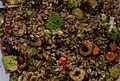 Freekeh with roasted vegetables
 -
 Firik ve bulgur


Freekeh
-
Freekeh with roasted vegetables
-
Firik ve bulgur
