Diffuse unilateral subacute neuroretinitis: Difference between revisions
CSV import |
CSV import Tags: mobile edit mobile web edit |
||
| Line 19: | Line 19: | ||
[[Category:Parasitic diseases]] | [[Category:Parasitic diseases]] | ||
{{medicine-stub}} | {{medicine-stub}} | ||
== Diffuse unilateral subacute neuroretinitis == | |||
<gallery> | |||
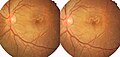
File:Diffuse_unilateral_subacute_neuroretinitis.jpg|Diffuse unilateral subacute neuroretinitis | |||
</gallery> | |||
Revision as of 02:09, 17 February 2025

Diffuse Unilateral Subacute Neuroretinitis (DUSN) is a rare ocular disease, primarily affecting the eye's retina and optic nerve. It is characterized by the presence of a parasitic infection, often caused by nematodes such as Toxocara canis or Baylisascaris procyonis. The condition is unilateral, affecting only one eye in most cases, and progresses subacutely, indicating a somewhat rapid development of symptoms over weeks to months.
Symptoms and Diagnosis
The initial symptoms of DUSN can be subtle and may include visual impairment, floaters, and scotoma (blind spots). As the disease progresses, more severe symptoms such as vitritis (inflammation of the vitreous body of the eye), papillitis (inflammation of the optic disc), and retinal vasculitis (inflammation of the retinal vessels) can develop. The diagnosis of DUSN is primarily clinical, based on the observation of the characteristic lesions in the retina and the presence of a motile subretinal nematode. Ancillary tests, including fluorescein angiography and optical coherence tomography (OCT), can aid in the diagnosis by revealing the extent of retinal and optic nerve damage.
Treatment
Treatment of DUSN is challenging and focuses on eliminating the parasitic infection and controlling the inflammatory response in the eye. Anti-parasitic medications, such as albendazole or ivermectin, are commonly used to target the nematode. Additionally, corticosteroids may be administered to reduce inflammation. In some cases, laser photocoagulation therapy is employed to directly target and destroy the nematode within the retina. Early diagnosis and treatment are crucial to prevent permanent visual impairment or blindness.
Epidemiology
DUSN is most commonly reported in tropical and subtropical regions, where the prevalence of the causative nematodes is higher. However, cases have been reported worldwide, indicating a global distribution. The disease predominantly affects children and young adults, but it can occur at any age. There is no known gender predilection.
Prevention
Prevention of DUSN involves controlling the spread of the causative nematodes, primarily through public health measures aimed at reducing human contact with contaminated soil and feces, which are common sources of nematode eggs. Regular deworming of pets, especially dogs, can also reduce the risk of transmission of Toxocara canis to humans.
Conclusion
Diffuse Unilateral Subacute Neuroretinitis is a serious ocular condition that can lead to significant visual impairment if not promptly diagnosed and treated. Awareness of the disease, particularly in endemic areas, and early intervention are key to preventing long-term visual sequelae.

Diffuse unilateral subacute neuroretinitis
-
 Diffuse unilateral subacute neuroretinitis
