Bar (unit): Difference between revisions
CSV import |
CSV import |
||
| Line 28: | Line 28: | ||
[[Category:Units of pressure]] | [[Category:Units of pressure]] | ||
[[Category:Non-SI metric units]] | [[Category:Non-SI metric units]] | ||
== Bar (unit) gallery == | |||
<gallery> | |||
File:Aluminium cylinder.jpg|Aluminium cylinder | |||
File:Day5pressureforecast.png|Day 5 pressure forecast | |||
File:ReifendruckPruefen.jpg|Checking tire pressure | |||
</gallery> | |||
Latest revision as of 05:37, 3 March 2025
Bar (unit)
The bar is a metric unit of pressure, but not part of the International System of Units (SI). It is defined as exactly equal to 100,000 Pascals, which is slightly less than the current average atmospheric pressure on Earth at sea level.
Definition and conversion[edit]
The bar is defined using the SI unit pascal, namely: 1 bar ≡ 100,000 Pa. A bar is therefore equal to:
- 100 kPa
- 1,000,000 dynes per square centimeter (baryes)
- 0.987 atmospheres
- 14.5038 pounds-force per square inch
Usage[edit]
The bar is widely used in descriptions of pressure because it is only about 1% smaller than the atmospheric pressure on Earth at sea level, which is 1.01325 bar. However, it is not an SI unit, and it is not recommended for use in scientific contexts by the IUPAC or the NIST.
History[edit]
The word bar has its origin in the Greek word βάρος (baros), meaning weight. Its official symbol is "bar"; the earlier "b" is now deprecated, but still often seen especially in "mb" rather than the proper "mbar" for millibars.
See also[edit]
| Pressure Units | ||||||||||
|---|---|---|---|---|---|---|---|---|---|---|
This pressure units related article is a stub.
|
| Units of Measurement | ||||||||||
|---|---|---|---|---|---|---|---|---|---|---|
This units of measurement related article is a stub.
|
 | This medical article is a stub. You can help WikiMD by expanding the page. |
Bar (unit) gallery[edit]
-
 Aluminium cylinder
 -
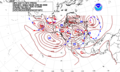 Day 5 pressure forecast
 -
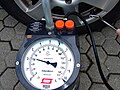 Checking tire pressure


