Sponge diving: Difference between revisions
CSV import |
CSV import |
||
| Line 27: | Line 27: | ||
{{diving-stub}} | {{diving-stub}} | ||
{{history-stub}} | {{history-stub}} | ||
<gallery> | |||
File:Sponge_diver_John_M._Gonatos_putting_on_his_diving_suit.jpg|Sponge diver John M. Gonatos putting on his diving suit | |||
File:Sponges.JPG|Sponges | |||
File:Sponge_fishing_LCCN2003666909.jpg|Sponge fishing | |||
</gallery> | |||
Latest revision as of 04:05, 18 February 2025
Sponge diving is the oldest known form of underwater diving to harvest natural sponges. Divers descend to the ocean floor to collect sponges and then ascend back to the surface. Sponge diving has been practiced for thousands of years, with the earliest evidence dating back to the Ancient Greeks.
History[edit]
The practice of sponge diving originated in the Mediterranean Sea during the time of the Ancient Greeks. They used diving bells and other primitive diving equipment to reach the ocean floor. The divers would then manually collect the sponges and bring them to the surface. The harvested sponges were used for a variety of purposes, including cleaning, bathing, and as padding in helmets and armor.
In the 19th century, sponge diving became a major industry in the Florida Keys, where the warm, shallow waters provided ideal conditions for sponge growth. The industry reached its peak in the early 20th century, but declined rapidly due to overfishing and the introduction of synthetic sponges.
Techniques[edit]
Sponge diving techniques have evolved over the centuries. Early divers used weights to descend quickly to the ocean floor and a rope to ascend. Modern sponge divers use scuba equipment, which allows them to stay underwater for longer periods of time.
The divers use a special tool called a diving knife to cut the sponge from the ocean floor. The sponge is then placed in a bag and brought to the surface.
Risks and Challenges[edit]
Sponge diving is a physically demanding and potentially dangerous activity. Divers face risks such as decompression sickness, also known as the bends, and hypothermia. Overfishing is also a major concern, as it can deplete sponge populations and disrupt marine ecosystems.
See Also[edit]
References[edit]
<references />

-
 Sponge diver John M. Gonatos putting on his diving suit
 -
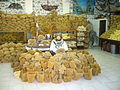 Sponges
 -
 Sponge fishing


