Transverse colon: Difference between revisions
CSV import |
CSV import |
||
| Line 1: | Line 1: | ||
{{Short description|Part of the large intestine}} | |||
{{Use dmy dates|date=October 2023}} | |||
The ''' | The '''transverse colon''' is the longest and most movable part of the [[large intestine]]. It crosses the abdomen from the [[right colic flexure]] to the [[left colic flexure]]. | ||
==Anatomy== | ==Anatomy== | ||
The transverse colon is a continuation of the [[ascending colon]] and extends from the right colic flexure, also known as the hepatic flexure, to the left colic flexure, or splenic flexure. It is suspended by the [[transverse mesocolon]], which allows it to be quite mobile. The transverse colon is located anterior to the [[small intestine]] and is bordered superiorly by the [[stomach]] and [[liver]]. | |||
The transverse colon | ===Blood Supply=== | ||
The blood supply to the transverse colon is primarily from the [[middle colic artery]], a branch of the [[superior mesenteric artery]]. The [[inferior mesenteric artery]] also contributes via the left colic artery. | |||
The transverse colon | ===Innervation=== | ||
The transverse colon receives its nerve supply from the [[autonomic nervous system]]. The [[vagus nerve]] provides parasympathetic innervation, while sympathetic innervation is supplied by the [[superior mesenteric plexus]]. | |||
==Function== | ==Function== | ||
The primary function of the transverse colon is to absorb water and salts from the material that has not been digested as food, and to store waste products until they are ready to be eliminated from the body. It plays a crucial role in the process of [[digestion]] and the formation of [[feces]]. | |||
The | ==Clinical Significance== | ||
The transverse colon can be involved in various medical conditions, such as [[colitis]], [[colon cancer]], and [[volvulus]]. It is also a common site for the accumulation of [[gas]] and can be affected by [[irritable bowel syndrome]] (IBS). | |||
== | ==Related pages== | ||
* [[Large intestine]] | |||
* [[Digestive system]] | |||
* [[Colon (anatomy)]] | |||
==Gallery== | |||
<gallery> | |||
File:ColonTrasverso.png|Diagram of the transverse colon | |||
File:Gray1223.png|Anatomical illustration of the large intestine | |||
File:Dickdarm-Schema.svg|Schematic of the large intestine | |||
File:Diameters_of_the_large_intestine.svg|Diameters of the large intestine | |||
File:Illu_intestine.jpg|Illustration of the intestines | |||
File:Gray989.png|Anatomy of the digestive system | |||
File:Gray1034.png|The colon and its parts | |||
File:Digestive_system_diagram_en.svg|Diagram of the digestive system | |||
File:Transverse_colon.jpg|Image of the transverse colon | |||
</gallery> | |||
==References== | ==References== | ||
* Moore, K. L., Dalley, A. F., & Agur, A. M. R. (2013). ''Clinically Oriented Anatomy''. Lippincott Williams & Wilkins. | |||
* Standring, S. (2015). ''Gray's Anatomy: The Anatomical Basis of Clinical Practice''. Elsevier Health Sciences. | |||
[[Category:Digestive system]] | [[Category:Digestive system]] | ||
[[Category: | [[Category:Large intestine]] | ||
Revision as of 00:42, 10 February 2025
Part of the large intestine
The transverse colon is the longest and most movable part of the large intestine. It crosses the abdomen from the right colic flexure to the left colic flexure.
Anatomy
The transverse colon is a continuation of the ascending colon and extends from the right colic flexure, also known as the hepatic flexure, to the left colic flexure, or splenic flexure. It is suspended by the transverse mesocolon, which allows it to be quite mobile. The transverse colon is located anterior to the small intestine and is bordered superiorly by the stomach and liver.
Blood Supply
The blood supply to the transverse colon is primarily from the middle colic artery, a branch of the superior mesenteric artery. The inferior mesenteric artery also contributes via the left colic artery.
Innervation
The transverse colon receives its nerve supply from the autonomic nervous system. The vagus nerve provides parasympathetic innervation, while sympathetic innervation is supplied by the superior mesenteric plexus.
Function
The primary function of the transverse colon is to absorb water and salts from the material that has not been digested as food, and to store waste products until they are ready to be eliminated from the body. It plays a crucial role in the process of digestion and the formation of feces.
Clinical Significance
The transverse colon can be involved in various medical conditions, such as colitis, colon cancer, and volvulus. It is also a common site for the accumulation of gas and can be affected by irritable bowel syndrome (IBS).
Related pages
Gallery
-
 Diagram of the transverse colon
 -
 Anatomical illustration of the large intestine
 -
 Schematic of the large intestine
 -
 Diameters of the large intestine
 -
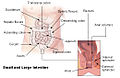 Illustration of the intestines
 -
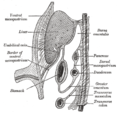 Anatomy of the digestive system
 -
 The colon and its parts
 -
 Diagram of the digestive system
 -
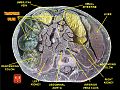 Image of the transverse colon


References
- Moore, K. L., Dalley, A. F., & Agur, A. M. R. (2013). Clinically Oriented Anatomy. Lippincott Williams & Wilkins.
- Standring, S. (2015). Gray's Anatomy: The Anatomical Basis of Clinical Practice. Elsevier Health Sciences.
