Acute limb ischaemia: Difference between revisions
CSV import |
CSV import |
||
| (2 intermediate revisions by the same user not shown) | |||
| Line 1: | Line 1: | ||
{{Infobox medical condition | |||
| name = Acute limb ischaemia | |||
| image =[[File:Arterial_thrombosis_causing_cyanosis.jpg|thumb|Arterial thrombosis causing cyanosis]] | |||
| caption = Arterial thrombosis causing cyanosis | |||
| field = [[Vascular surgery]] | |||
| symptoms = [[Pain]], [[pallor]], [[pulselessness]], [[paresthesia]], [[paralysis]], [[poikilothermia]] | |||
| complications = [[Tissue necrosis]], [[gangrene]], [[amputation]] | |||
| onset = Sudden | |||
| duration = Hours to days | |||
| causes = [[Embolism]], [[thrombosis]], [[trauma]] | |||
| risks = [[Atrial fibrillation]], [[peripheral artery disease]], [[smoking]], [[diabetes mellitus]] | |||
| diagnosis = [[Doppler ultrasound]], [[angiography]] | |||
| differential = [[Deep vein thrombosis]], [[compartment syndrome]] | |||
| treatment = [[Anticoagulation]], [[thrombolysis]], [[surgery]] | |||
| prognosis = Variable, depends on time to treatment | |||
| frequency = Common in patients with [[cardiovascular disease]] | |||
}} | |||
Acute Limb Ischaemia | |||
[[File:Arterial_thrombosis_causing_cyanosis.jpg|thumb|Arterial thrombosis causing cyanosis]] | |||
[[File:Acuteoccluisionaxartery.png|thumb|Acute occlusion of the axillary artery]] | |||
[[File:Angiograph_before_and_after_thrombolytic_therapy_in_a_case_of_thrombosis_on_the_hand.png|thumb|Angiograph before and after thrombolytic therapy in a case of thrombosis on the hand]] | |||
Acute limb ischaemia | '''Acute limb ischaemia''' (ALI) is a sudden decrease in [[blood flow]] to a limb, threatening its viability. It is a medical emergency that requires prompt diagnosis and treatment to prevent [[tissue necrosis]] and potential [[amputation]]. | ||
==Causes== | |||
Acute limb ischaemia can result from several causes, including: | |||
* [[Embolism]]: A blood clot or other debris travels through the bloodstream and lodges in a limb artery. | |||
* [[Thrombosis]]: A blood clot forms in a limb artery, often due to underlying [[atherosclerosis]]. | |||
* [[Trauma]]: Physical injury to a limb can damage blood vessels, leading to ischaemia. | |||
* [[Aortic dissection]]: A tear in the [[aorta]] can extend into limb arteries, reducing blood flow. | |||
== | ==Symptoms== | ||
The classic symptoms of acute limb ischaemia are often referred to as the "six Ps": | |||
* [[Pain]] | |||
* [[Pallor]] | |||
* [[Pulselessness]] | |||
* [[Paresthesia]] | |||
* [[Paralysis]] | |||
* [[Poikilothermia]] (coolness) | |||
==Diagnosis== | |||
Diagnosis of acute limb ischaemia involves a combination of clinical assessment and imaging studies. Common diagnostic tools include: | |||
* [[Doppler ultrasound]]: To assess blood flow in the affected limb. | |||
* [[Angiography]]: Provides detailed images of blood vessels to identify blockages. | |||
* [[Magnetic resonance imaging]] (MRI) or [[computed tomography]] (CT) angiography: Non-invasive imaging techniques to visualize blood vessels. | |||
==Treatment== | |||
The treatment of acute limb ischaemia aims to restore blood flow and prevent tissue damage. Options include: | |||
* [[Thrombolysis]]: Administration of drugs to dissolve blood clots. | |||
* [[Surgical embolectomy]]: Removal of the embolus or thrombus through surgery. | |||
* [[Bypass surgery]]: Creating a new pathway for blood flow around the blocked artery. | |||
* [[Amputation]]: In severe cases where tissue death has occurred, amputation may be necessary. | |||
The | ==Prognosis== | ||
The prognosis of acute limb ischaemia depends on the severity and duration of the ischaemia, as well as the underlying cause. Prompt treatment can significantly improve outcomes and limb salvage rates. | |||
==Prevention== | |||
Preventive measures focus on managing risk factors for vascular disease, such as: | |||
* [[Smoking cessation]] | |||
* [[Blood pressure]] control | |||
* [[Cholesterol management]] | |||
* [[Diabetes management]] | |||
==Related pages== | |||
* [[Peripheral artery disease]] | * [[Peripheral artery disease]] | ||
* [[Chronic limb-threatening ischaemia]] | * [[Chronic limb-threatening ischaemia]] | ||
* [[Vascular surgery]] | * [[Vascular surgery]] | ||
* [[Thrombosis]] | |||
[[Category:Vascular diseases]] | |||
[[Category:Medical emergencies]] | |||
<gallery> | <gallery> | ||
File:Arterial_thrombosis_causing_cyanosis.jpg|Arterial thrombosis causing cyanosis | File:Arterial_thrombosis_causing_cyanosis.jpg|Arterial thrombosis causing cyanosis | ||
File:Acuteoccluisionaxartery.png|Acute occlusion of | File:Acuteoccluisionaxartery.png|Acute occlusion of axillary artery | ||
File:Angiograph_before_and_after_thrombolytic_therapy_in_a_case_of_thrombosis_on_the_hand.png|Angiograph before and after thrombolytic therapy | File:Angiograph_before_and_after_thrombolytic_therapy_in_a_case_of_thrombosis_on_the_hand.png|Angiograph before and after thrombolytic therapy in a case of thrombosis on the hand | ||
</gallery> | </gallery> | ||
Latest revision as of 03:28, 4 April 2025
| Acute limb ischaemia | |
|---|---|
 | |
| Synonyms | N/A |
| Pronounce | N/A |
| Specialty | N/A |
| Symptoms | Pain, pallor, pulselessness, paresthesia, paralysis, poikilothermia |
| Complications | Tissue necrosis, gangrene, amputation |
| Onset | Sudden |
| Duration | Hours to days |
| Types | N/A |
| Causes | Embolism, thrombosis, trauma |
| Risks | Atrial fibrillation, peripheral artery disease, smoking, diabetes mellitus |
| Diagnosis | Doppler ultrasound, angiography |
| Differential diagnosis | Deep vein thrombosis, compartment syndrome |
| Prevention | N/A |
| Treatment | Anticoagulation, thrombolysis, surgery |
| Medication | N/A |
| Prognosis | Variable, depends on time to treatment |
| Frequency | Common in patients with cardiovascular disease |
| Deaths | N/A |
Acute Limb Ischaemia


Acute limb ischaemia (ALI) is a sudden decrease in blood flow to a limb, threatening its viability. It is a medical emergency that requires prompt diagnosis and treatment to prevent tissue necrosis and potential amputation.
Causes[edit]
Acute limb ischaemia can result from several causes, including:
- Embolism: A blood clot or other debris travels through the bloodstream and lodges in a limb artery.
- Thrombosis: A blood clot forms in a limb artery, often due to underlying atherosclerosis.
- Trauma: Physical injury to a limb can damage blood vessels, leading to ischaemia.
- Aortic dissection: A tear in the aorta can extend into limb arteries, reducing blood flow.
Symptoms[edit]
The classic symptoms of acute limb ischaemia are often referred to as the "six Ps":
- Pain
- Pallor
- Pulselessness
- Paresthesia
- Paralysis
- Poikilothermia (coolness)
Diagnosis[edit]
Diagnosis of acute limb ischaemia involves a combination of clinical assessment and imaging studies. Common diagnostic tools include:
- Doppler ultrasound: To assess blood flow in the affected limb.
- Angiography: Provides detailed images of blood vessels to identify blockages.
- Magnetic resonance imaging (MRI) or computed tomography (CT) angiography: Non-invasive imaging techniques to visualize blood vessels.
Treatment[edit]
The treatment of acute limb ischaemia aims to restore blood flow and prevent tissue damage. Options include:
- Thrombolysis: Administration of drugs to dissolve blood clots.
- Surgical embolectomy: Removal of the embolus or thrombus through surgery.
- Bypass surgery: Creating a new pathway for blood flow around the blocked artery.
- Amputation: In severe cases where tissue death has occurred, amputation may be necessary.
Prognosis[edit]
The prognosis of acute limb ischaemia depends on the severity and duration of the ischaemia, as well as the underlying cause. Prompt treatment can significantly improve outcomes and limb salvage rates.
Prevention[edit]
Preventive measures focus on managing risk factors for vascular disease, such as:
Related pages[edit]
-
 Arterial thrombosis causing cyanosis
 -
 Acute occlusion of axillary artery
 -
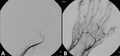 Angiograph before and after thrombolytic therapy in a case of thrombosis on the hand
