Ravioli: Difference between revisions
CSV import |
CSV import |
||
| (One intermediate revision by the same user not shown) | |||
| Line 1: | Line 1: | ||
{{Infobox food | {{Infobox food | ||
| name = Ravioli | | name = Ravioli | ||
| image = | | image = | ||
| caption = A plate of | | caption = A plate of ravioli | ||
| country = Italy | | country = Italy | ||
| region = | | region = | ||
| course = Main course | |||
| course = Main | | type = Pasta | ||
| | | main_ingredient = [[Pasta]], [[Cheese]], [[Meat]], [[Vegetables]] | ||
| main_ingredient = | |||
}} | }} | ||
'''Ravioli''' are a type of [[pasta]] | |||
'''Ravioli''' are a type of [[pasta]] comprising a filling enveloped in thin pasta dough. They are typically served in [[broth]] or with a [[sauce]]. | |||
==History== | ==History== | ||
Ravioli have a long history in [[Italian cuisine]], with the earliest mentions dating back to the 14th century. The word "ravioli" is derived from the Italian word "riavvolgere," which means "to wrap." | |||
==Preparation== | ==Preparation== | ||
Ravioli are made by placing a filling between two layers of pasta dough, which are then sealed around the edges. The filling can vary widely, including [[cheese]], [[meat]], [[vegetables]], or a combination of these ingredients. Common cheese fillings include [[ricotta]] and [[parmesan]]. | |||
== | |||
Ravioli can be | ===Dough=== | ||
The dough for ravioli is typically made from [[wheat flour]] and [[eggs]], which are mixed to form a smooth, elastic dough. The dough is then rolled out into thin sheets. | |||
===Filling=== | |||
The filling is placed in small mounds on one sheet of pasta, and another sheet is placed on top. The pasta is then cut into individual pieces, each containing a portion of filling. | |||
==Serving== | |||
Ravioli can be served in a variety of ways. They are often boiled and served with a [[tomato sauce]], [[cream sauce]], or simply with [[butter]] and [[sage]]. In some regions, ravioli are served in a [[broth]] as a soup. | |||
==Variations== | ==Variations== | ||
There are | There are many regional variations of ravioli throughout Italy and the world. In [[Sardinia]], ravioli are often filled with [[ricotta]] and [[lemon]] zest. In [[Tuscany]], they may be filled with [[spinach]] and [[ricotta]]. | ||
== | |||
Ravioli | ==Nutritional Information== | ||
Ravioli are a good source of [[carbohydrates]] and [[protein]], depending on the filling. They can be high in [[calories]] and [[fat]] if filled with cheese or meat and served with a rich sauce. | |||
==See also== | |||
* [[Tortellini]] | |||
* [[Agnolotti]] | |||
* [[Pasta]] | |||
==References== | |||
{{Reflist}} | |||
==External links== | |||
* [https://www.wikimd.com/wiki/Ravioli Ravioli on WikiMD] | |||
[[Category:Pasta]] | |||
[[Category:Italian cuisine]] | [[Category:Italian cuisine]] | ||
[[Category: | [[Category:Stuffed dishes]] | ||
== Ravioli == | |||
<gallery> | |||
File:Flickr - cyclonebill - Ravioli med skinke og asparges i mascarponecreme.jpg|Ravioli with ham and asparagus in mascarpone cream | |||
File:Ravioli di lattuga.jpg|Lettuce ravioli | |||
File:Ravioli-casalinghi-con-la-ricotta.JPG|Homemade ravioli with ricotta | |||
</gallery> | |||
Latest revision as of 01:06, 20 February 2025
| [[File:|frameless|alt=]] | |
| A plate of ravioli | |
| Alternative names | |
| Type | Pasta |
| Course | Main course |
| Place of origin | Italy |
| Region or state | |
| Associated national cuisine | |
| Created by | |
| Invented | |
| Cooking time | minutes to minutes |
| Serving temperature | |
| Main ingredients | Pasta, Cheese, Meat, Vegetables |
| Ingredients generally used | |
| Variations | |
| Food energy | kcal |
| Nutritional value | Protein: g, Fat: g, Carbohydrate: g |
| Glycemic index | |
| Similar dishes | |
| Other information | |
| Website | [ Official website] |
Ravioli are a type of pasta comprising a filling enveloped in thin pasta dough. They are typically served in broth or with a sauce.
History[edit]
Ravioli have a long history in Italian cuisine, with the earliest mentions dating back to the 14th century. The word "ravioli" is derived from the Italian word "riavvolgere," which means "to wrap."
Preparation[edit]
Ravioli are made by placing a filling between two layers of pasta dough, which are then sealed around the edges. The filling can vary widely, including cheese, meat, vegetables, or a combination of these ingredients. Common cheese fillings include ricotta and parmesan.
Dough[edit]
The dough for ravioli is typically made from wheat flour and eggs, which are mixed to form a smooth, elastic dough. The dough is then rolled out into thin sheets.
Filling[edit]
The filling is placed in small mounds on one sheet of pasta, and another sheet is placed on top. The pasta is then cut into individual pieces, each containing a portion of filling.
Serving[edit]
Ravioli can be served in a variety of ways. They are often boiled and served with a tomato sauce, cream sauce, or simply with butter and sage. In some regions, ravioli are served in a broth as a soup.
Variations[edit]
There are many regional variations of ravioli throughout Italy and the world. In Sardinia, ravioli are often filled with ricotta and lemon zest. In Tuscany, they may be filled with spinach and ricotta.
Nutritional Information[edit]
Ravioli are a good source of carbohydrates and protein, depending on the filling. They can be high in calories and fat if filled with cheese or meat and served with a rich sauce.
See also[edit]
References[edit]
External links[edit]
Ravioli[edit]
-
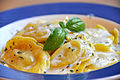 Ravioli with ham and asparagus in mascarpone cream
 -
 Lettuce ravioli
 -
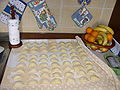 Homemade ravioli with ricotta


