Creamed honey: Difference between revisions
CSV import |
CSV import |
||
| (2 intermediate revisions by the same user not shown) | |||
| Line 1: | Line 1: | ||
'''Creamed honey''', also known as | '''Creamed honey''', also known as whipped honey, spun honey, or churned honey, is a type of [[honey]] that has been processed to control crystallization. The process results in a smooth, spreadable consistency that is preferred by many consumers over liquid honey. | ||
==Production== | == Production Process == | ||
The production of creamed honey involves controlling the crystallization process of honey. Natural honey crystallizes over time, but the size of the crystals can vary, leading to a gritty texture. Creamed honey is made by inducing the formation of small crystals, which results in a smooth texture. | |||
The | |||
The process typically involves the following steps: | |||
# '''Seed Honey:''' A small amount of finely crystallized honey, known as "seed honey," is added to liquid honey. This seed honey acts as a template for the crystallization process. | |||
# '''Mixing:''' The mixture is stirred to ensure even distribution of the seed crystals throughout the liquid honey. | |||
# '''Cooling:''' The honey is then cooled to a temperature that promotes crystallization. | |||
# '''Storage:''' The honey is stored at a controlled temperature until the desired consistency is achieved. | |||
== | == Characteristics == | ||
Creamed honey | |||
Creamed honey has several characteristics that distinguish it from other forms of honey: | |||
* '''Texture:''' The texture is smooth and spreadable, similar to that of butter or margarine. | |||
* '''Flavor:''' The flavor of creamed honey is the same as the original honey, as the process does not alter its taste. | |||
* '''Stability:''' Creamed honey does not separate or crystallize further, making it stable over time. | |||
== Uses == | |||
Creamed honey is used in a variety of culinary applications. It is often spread on [[bread]], [[toast]], or [[crackers]]. It can also be used as a sweetener in [[tea]], [[coffee]], or [[baked goods]]. | |||
== Related Pages == | |||
* [[Honey]] | * [[Honey]] | ||
* [[Beekeeping]] | * [[Beekeeping]] | ||
* [[ | * [[Crystallization]] | ||
* [[Food processing]] | |||
[[Category:Honey]] | [[Category:Honey]] | ||
[[Category:Food processing]] | |||
<gallery> | |||
File:Крем-мед_Honey-city.jpg|Creamed honey | |||
</gallery> | |||
Latest revision as of 21:43, 20 February 2025
Creamed honey, also known as whipped honey, spun honey, or churned honey, is a type of honey that has been processed to control crystallization. The process results in a smooth, spreadable consistency that is preferred by many consumers over liquid honey.
Production Process[edit]
The production of creamed honey involves controlling the crystallization process of honey. Natural honey crystallizes over time, but the size of the crystals can vary, leading to a gritty texture. Creamed honey is made by inducing the formation of small crystals, which results in a smooth texture.
The process typically involves the following steps:
- Seed Honey: A small amount of finely crystallized honey, known as "seed honey," is added to liquid honey. This seed honey acts as a template for the crystallization process.
- Mixing: The mixture is stirred to ensure even distribution of the seed crystals throughout the liquid honey.
- Cooling: The honey is then cooled to a temperature that promotes crystallization.
- Storage: The honey is stored at a controlled temperature until the desired consistency is achieved.
Characteristics[edit]
Creamed honey has several characteristics that distinguish it from other forms of honey:
- Texture: The texture is smooth and spreadable, similar to that of butter or margarine.
- Flavor: The flavor of creamed honey is the same as the original honey, as the process does not alter its taste.
- Stability: Creamed honey does not separate or crystallize further, making it stable over time.
Uses[edit]
Creamed honey is used in a variety of culinary applications. It is often spread on bread, toast, or crackers. It can also be used as a sweetener in tea, coffee, or baked goods.
Related Pages[edit]
-
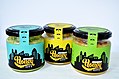 Creamed honey

