Swainsonine: Difference between revisions
CSV import |
CSV import |
||
| Line 32: | Line 32: | ||
{{biochemistry-stub}} | {{biochemistry-stub}} | ||
{{medicine-stub}} | {{medicine-stub}} | ||
<gallery> | |||
File:Swainsonine_Formula_V.1.svg|Chemical structure of Swainsonine | |||
File:Swainsonine_Biosynthesis_Scheme.gif|Biosynthesis scheme of Swainsonine | |||
File:Swainsonine_synthesis_from_common_precursors.png|Synthesis of Swainsonine from common precursors | |||
</gallery> | |||
Latest revision as of 04:03, 18 February 2025
Swainsonine is a naturally occurring alkaloid that is found in various plants and fungi. It is named after the British naturalist Henry Swainson, who first identified it. Swainsonine is known for its toxic effects on livestock and has been the subject of extensive research in the field of veterinary medicine and biochemistry.
History[edit]
Swainsonine was first identified in the 1970s in the plant Swainsona canescens, commonly known as Darling pea. The plant was linked to a condition known as pea struck in sheep, which caused neurological and reproductive problems. Further research revealed that the toxic effects were due to the presence of swainsonine.
Sources[edit]
Swainsonine is found in a variety of plants and fungi, including members of the Astragalus, Oxytropis, and Ipomoea genera. It is also produced by the fungus Metarhizium anisopliae, which is used as a biological insecticide.
Biochemistry[edit]
Swainsonine inhibits the enzyme alpha-mannosidase, which is involved in the processing of glycoproteins. This inhibition leads to an accumulation of improperly processed glycoproteins, which can disrupt cellular function and lead to cell death.
Toxicity[edit]
In livestock, ingestion of swainsonine-containing plants can lead to a condition known as locoism. Symptoms include weight loss, neurological problems, and reproductive issues. In severe cases, it can be fatal. Swainsonine is also toxic to humans, although cases of poisoning are rare.
Research[edit]
Swainsonine has been the subject of extensive research due to its potential therapeutic applications. It has been investigated as a potential treatment for cancer, HIV, and certain parasitic diseases.
See also[edit]
.svg)
This article is a biochemistry stub. You can help WikiMD by expanding it!

-
 Chemical structure of Swainsonine
 -
 Biosynthesis scheme of Swainsonine
 -
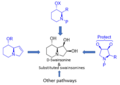 Synthesis of Swainsonine from common precursors


