Osmanthus fragrans: Difference between revisions
CSV import |
CSV import |
||
| Line 28: | Line 28: | ||
[[Category:Culinary herbs and spices]] | [[Category:Culinary herbs and spices]] | ||
[[Category:Flowering plants]] | [[Category:Flowering plants]] | ||
== Osmanthus fragrans == | |||
<gallery> | |||
File:Osmanthus_fragrans_(orange_flowers).jpg|Osmanthus fragrans with orange flowers | |||
File:Sweetosmanthussauce.jpg|Sweet osmanthus sauce | |||
File:Sweet_Tea_Olive_Cake.jpg|Sweet Tea Olive Cake | |||
File:20241023_211934_Copy.jpg|Osmanthus fragrans | |||
File:Osmanthus_Fragrans_chinese_Guihua.JPG|Osmanthus fragrans Chinese Guihua | |||
</gallery> | |||
Latest revision as of 04:35, 18 February 2025
Osmanthus fragrans, also known as sweet osmanthus, fragrant olive, tea olive, and sweet olive, is a species of flowering plant in the family Oleaceae. It is native to Asia, particularly East Asia and the Himalayas, but has been cultivated and naturalized in other parts of the world.
Description[edit]
Osmanthus fragrans is an evergreen shrub or small tree that grows to a height of 3-12 meters. The leaves are 7-15 cm long and 2.6-5 cm broad, with a margin that is finely toothed. The flowers are white, pale yellow, yellow, or orange-yellow, small (1 cm long), with a four-lobed corolla 5 mm diameter, and have a strong fragrance. The fruit is a purple-black drupe 10–15 mm long containing a single hard-shelled seed.
Cultivation and uses[edit]
Osmanthus fragrans is cultivated as an ornamental plant for its flowers, which are used in perfumery and to make herbal tea. The flowers are also used in Chinese cuisine to flavor dishes and desserts. In Chinese culture, osmanthus is associated with the Mid-Autumn Festival, as its flowering period usually coincides with the festival.
In traditional Chinese medicine, Osmanthus fragrans is used to transform phlegm, clear heat, and relieve cough. It is also used to promote good skin, treat toothache, and improve appetite.
Varieties[edit]
There are several varieties of Osmanthus fragrans, including:
- Osmanthus fragrans var. fragrans - white or pale yellow flowers
- Osmanthus fragrans var. aurantiacus - orange or reddish flowers
- Osmanthus fragrans var. thunbergii - yellow flowers
See also[edit]


Osmanthus fragrans[edit]
-
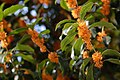 Osmanthus fragrans with orange flowers
 -
Sweet osmanthus sauce
-
Sweet Tea Olive Cake
-
Osmanthus fragrans
-
Osmanthus fragrans Chinese Guihua
.jpg)


