Sweet lemon: Difference between revisions
CSV import |
CSV import |
||
| Line 29: | Line 29: | ||
[[Category:Agriculture]] | [[Category:Agriculture]] | ||
{{Citrus-stub}} | {{Citrus-stub}} | ||
<gallery> | |||
File:(Citrus_limetta)_Mosambi_at_a_market_in_Seethammadhara.jpg|Sweet lemon at a market in Seethammadhara | |||
File:Sweet_limes_of_Salem.jpg|Sweet limes of Salem | |||
File:Castello,_collezione_degli_agrumi_02.jpg|Sweet lemon | |||
</gallery> | |||
Latest revision as of 04:49, 18 February 2025
Sweet Lemon is a type of citrus fruit that is known for its sweet and fragrant flavor. Unlike other citrus fruits, the sweet lemon lacks the typical acidity that characterizes these fruits.
Origin and Distribution[edit]
The sweet lemon is believed to have originated in India, China, or Southeast Asia, where citrus fruits have been cultivated for thousands of years. Today, sweet lemons are grown in many parts of the world, including the Mediterranean region, South America, and the United States.
Description[edit]
The sweet lemon tree is a small to medium-sized evergreen with glossy leaves and fragrant flowers. The fruit is round or oblong, and typically measures between 7 and 12 cm in diameter. The peel is thin and yellow, while the flesh is light yellow and contains a high amount of juice. The sweet lemon is unique among citrus fruits in that its juice is sweet rather than acidic.
Uses[edit]
Sweet lemons are often consumed fresh, but they can also be used in a variety of culinary applications. The juice can be used in beverages, desserts, and sauces, while the zest can be used to add flavor to baked goods and dishes. In addition, the sweet lemon is also used in traditional medicine in some cultures, and the essential oil extracted from the peel is used in aromatherapy and perfumery.
Cultivation[edit]
Sweet lemon trees prefer a subtropical to tropical climate, and require plenty of sunlight and well-drained soil. They are propagated by grafting, and start bearing fruit 3 to 6 years after planting. The trees are relatively hardy and resistant to most pests and diseases, but they can be affected by citrus greening disease, which is a serious threat to citrus cultivation worldwide.
Varieties[edit]
There are several varieties of sweet lemon, including the 'Limon Dulce', 'Limoncito Dulce', and 'Djeruk Limau'. These varieties differ in terms of size, shape, flavor, and other characteristics.
Nutritional Value[edit]
Sweet lemons are a good source of vitamin C, and also contain small amounts of vitamin A, calcium, and iron. They are low in calories and high in dietary fiber.
See Also[edit]

-
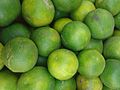 Sweet lemon at a market in Seethammadhara
 -
 Sweet limes of Salem
 -
 Sweet lemon
_Mosambi_at_a_market_in_Seethammadhara.jpg)


