Willardiine
Willardiine is a chemical compound that is used as a selective agonist for the AMPA and kainate receptors, two types of ionotropic glutamate receptors in the brain. It is named after the American chemist Robert Willard, who first synthesized it in the 1960s.
History[edit]
Robert Willard first synthesized Willardiine in the 1960s. The compound was initially studied for its potential use in agriculture, but its effects on the nervous system were soon recognized. Since then, it has been used as a tool in neuroscience research to study the function of glutamate receptors.
Structure and Properties[edit]
Willardiine is a derivative of uracil, one of the four nucleobases in the nucleic acid of RNA. It has a pyrimidine ring structure, with two carbonyl groups at the 1 and 3 positions, and an amino group at the 4 position. The 2 position is substituted with a side chain, which can vary to produce different analogs of Willardiine.
Biological Activity[edit]
Willardiine acts as a selective agonist for the AMPA receptor and kainate receptor, two types of ionotropic glutamate receptors. These receptors are involved in fast synaptic transmission in the central nervous system. By activating these receptors, Willardiine can mimic the effects of glutamate, the main excitatory neurotransmitter in the brain.
Uses[edit]
Willardiine and its analogs are primarily used in neuroscience research. They are used to study the function of AMPA and kainate receptors, and to investigate the role of these receptors in neurological and psychiatric disorders. Some analogs of Willardiine have also been investigated for their potential use in the treatment of neurodegenerative diseases, such as Alzheimer's disease and Parkinson's disease.
See Also[edit]
References[edit]

 | This neuroscience article is a stub. You can help WikiMD by expanding the page. |
-
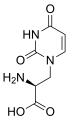 Willardiine
 -
 Mariosousa willardiana at Mildred E. Mathias Botanical Garden
 -
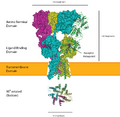 AMPA receptor
 -
 Kainate receptor
 -
 Willardiine biosynthesis
 -
 Willardiine synthesis
 -
 General structure of Willardiine antagonist


Medical Disclaimer: WikiMD is for informational purposes only and is not a substitute for professional medical advice. Content may be inaccurate or outdated and should not be used for diagnosis or treatment. Always consult your healthcare provider for medical decisions. Verify information with trusted sources such as CDC.gov and NIH.gov. By using this site, you agree that WikiMD is not liable for any outcomes related to its content. See full disclaimer.
Credits:Most images are courtesy of Wikimedia commons, and templates, categories Wikipedia, licensed under CC BY SA or similar.
Translate page: - East Asian
中文,
日本,
한국어,
South Asian
हिन्दी,
தமிழ்,
తెలుగు,
Urdu,
ಕನ್ನಡ,
Southeast Asian
Indonesian,
Vietnamese,
Thai,
မြန်မာဘာသာ,
বাংলা
European
español,
Deutsch,
français,
Greek,
português do Brasil,
polski,
română,
русский,
Nederlands,
norsk,
svenska,
suomi,
Italian
Middle Eastern & African
عربى,
Turkish,
Persian,
Hebrew,
Afrikaans,
isiZulu,
Kiswahili,
Other
Bulgarian,
Hungarian,
Czech,
Swedish,
മലയാളം,
मराठी,
ਪੰਜਾਬੀ,
ગુજરાતી,
Portuguese,
Ukrainian

