Viviparity
Viviparity is a term used in biology to describe animals that give birth to live offspring, rather than laying eggs. This is a characteristic of most mammals, some reptiles, and a few fish and amphibians. Viviparity is a complex trait that has evolved independently in various animal lineages.
Overview[edit]
Viviparity involves the development of the embryo within the body of the parent, eventually leading to live birth. This is in contrast to oviparity, where the embryo develops outside the parent's body, typically within an egg. There are various forms of viviparity, ranging from ovoviviparity, where the eggs remain in the parent's body but there is no placental connection, to placental viviparity, where the embryo is connected to the parent via a placenta and receives nutrients directly from the parent.
Evolution[edit]
The evolution of viviparity is thought to have occurred as a response to environmental pressures. In some species, viviparity may provide a survival advantage by protecting the developing young from predators or harsh environmental conditions. It may also allow for more efficient nutrient transfer from parent to offspring, leading to faster growth and development.
Examples[edit]
Examples of viviparous animals include most mammals, such as humans, dogs, and cats. Some reptiles, such as certain species of snake and lizard, are also viviparous. In the fish world, examples include the guppy and the shark. Some amphibians, such as the salamander, are also viviparous.
See also[edit]

This WikiMD article can only be edited by registered and verified editors. You can log in or register.
-
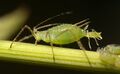 Aphid giving birth
 -
Viviparity


Medical Disclaimer: WikiMD is for informational purposes only and is not a substitute for professional medical advice. Content may be inaccurate or outdated and should not be used for diagnosis or treatment. Always consult your healthcare provider for medical decisions. Verify information with trusted sources such as CDC.gov and NIH.gov. By using this site, you agree that WikiMD is not liable for any outcomes related to its content. See full disclaimer.
Credits:Most images are courtesy of Wikimedia commons, and templates, categories Wikipedia, licensed under CC BY SA or similar.
Translate page: - East Asian
中文,
日本,
한국어,
South Asian
हिन्दी,
தமிழ்,
తెలుగు,
Urdu,
ಕನ್ನಡ,
Southeast Asian
Indonesian,
Vietnamese,
Thai,
မြန်မာဘာသာ,
বাংলা
European
español,
Deutsch,
français,
Greek,
português do Brasil,
polski,
română,
русский,
Nederlands,
norsk,
svenska,
suomi,
Italian
Middle Eastern & African
عربى,
Turkish,
Persian,
Hebrew,
Afrikaans,
isiZulu,
Kiswahili,
Other
Bulgarian,
Hungarian,
Czech,
Swedish,
മലയാളം,
मराठी,
ਪੰਜਾਬੀ,
ગુજરાતી,
Portuguese,
Ukrainian


_(21057027940).jpg)