Virtual colonoscopy
Virtual colonoscopy (also known as CT colonography or CTC) is a medical imaging procedure that uses x-rays and computers to produce two- and three-dimensional images of the colon (large intestine) from the lowest part, the rectum, all the way to the lower end of the small intestine and display them on a screen.
The procedure is used to diagnose colon and bowel disease, including polyps, diverticulosis and cancer. CT colonography is less invasive than traditional colonoscopy and has a lower risk of complications. However, if polyps or other abnormal growths are found during CT colonography, a traditional colonoscopy usually will be performed to remove them.
Procedure[edit]
The patient lies on a narrow table that slides into the center of a CT scanner. In some cases, a contrast material may be used to help visualize certain structures. Once inside the scanner, the machine's x-ray beam rotates around the patient. (Modern "spiral" scanners can perform the exam without stopping.)
A computer creates separate images of the body area, called slices. These images can be stored, viewed on a monitor, or printed on film. Three-dimensional models of the colon can be created by stacking the slices together.
Benefits and Risks[edit]
The benefits of CT colonography include: it is less invasive than traditional colonoscopy; it has a lower risk of complications; it can visualize the entire colon; it can detect polyps and cancer at an early stage.
The risks of CT colonography include: it can miss small polyps; it can produce false-positive results; it uses low doses of radiation, which have the potential to increase the risk of cancer; some people can have an allergic reaction to the contrast material.
See also[edit]

This WikiMD article can only be edited by registered and verified editors. You can log in or register.
-
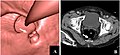 CT colonography of a rectal mass
 -
 Virtual colonoscopy


Medical Disclaimer: WikiMD is for informational purposes only and is not a substitute for professional medical advice. Content may be inaccurate or outdated and should not be used for diagnosis or treatment. Always consult your healthcare provider for medical decisions. Verify information with trusted sources such as CDC.gov and NIH.gov. By using this site, you agree that WikiMD is not liable for any outcomes related to its content. See full disclaimer.
Credits:Most images are courtesy of Wikimedia commons, and templates, categories Wikipedia, licensed under CC BY SA or similar.
Translate page: - East Asian
中文,
日本,
한국어,
South Asian
हिन्दी,
தமிழ்,
తెలుగు,
Urdu,
ಕನ್ನಡ,
Southeast Asian
Indonesian,
Vietnamese,
Thai,
မြန်မာဘာသာ,
বাংলা
European
español,
Deutsch,
français,
Greek,
português do Brasil,
polski,
română,
русский,
Nederlands,
norsk,
svenska,
suomi,
Italian
Middle Eastern & African
عربى,
Turkish,
Persian,
Hebrew,
Afrikaans,
isiZulu,
Kiswahili,
Other
Bulgarian,
Hungarian,
Czech,
Swedish,
മലയാളം,
मराठी,
ਪੰਜਾਬੀ,
ગુજરાતી,
Portuguese,
Ukrainian

