Colorectal adenoma

Editor-In-Chief: Prab R Tumpati, MD
Obesity, Sleep & Internal medicine
Founder, WikiMD Wellnesspedia &
W8MD's weight loss doctor NYC
Philadelphia GLP-1 weight loss and GLP-1 clinic NYC
| Colorectal adenoma | |
|---|---|
 | |
| Synonyms | Adenomatous polyp |
| Pronounce | N/A |
| Specialty | N/A |
| Symptoms | Often asymptomatic, may cause rectal bleeding |
| Complications | Colorectal cancer |
| Onset | Typically in adults over 50 |
| Duration | Can persist until removed |
| Types | Tubular adenoma, Villous adenoma, Tubulovillous adenoma |
| Causes | Genetic mutations, dietary factors |
| Risks | Age, family history, diet high in red meat |
| Diagnosis | Colonoscopy, biopsy |
| Differential diagnosis | Hyperplastic polyp, inflammatory polyp |
| Prevention | Regular screening, dietary changes |
| Treatment | Polypectomy, surgical resection |
| Medication | N/A |
| Prognosis | Good if removed early |
| Frequency | Common in adults over 50 |
| Deaths | N/A |
Colorectal adenoma is a type of polyp that is found in the colon or rectum. Colorectal adenomas are considered precancerous conditions, as they can develop into colorectal cancer if left untreated.
Types of Colorectal Adenoma[edit]
There are three main types of colorectal adenomas: tubular adenomas, villous adenomas, and tubulovillous adenomas.
- Tubular adenoma is the most common type of colorectal adenoma. It is typically small and has a lower risk of becoming cancerous compared to other types of adenomas.
- Villous adenoma is less common but more likely to become cancerous. It is often larger and has a villous or "finger-like" appearance under the microscope.
- Tubulovillous adenoma is a mix of tubular and villous adenoma. It has an intermediate risk of becoming cancerous.
Risk Factors[edit]
Several factors can increase the risk of developing colorectal adenomas. These include age, a history of colorectal adenomas or colorectal cancer, certain genetic syndromes such as Lynch syndrome and Familial adenomatous polyposis, and lifestyle factors such as diet, smoking, and lack of physical activity.
Diagnosis[edit]
Colorectal adenomas are often found during a colonoscopy or sigmoidoscopy. If an adenoma is found, it is usually removed and sent to a lab for testing. The lab can confirm whether the polyp is an adenoma and whether it has any signs of cancer.
Treatment[edit]
The primary treatment for colorectal adenomas is removal during a colonoscopy or sigmoidoscopy. This is usually done using a procedure called a polypectomy. In some cases, if the adenoma is very large or if there are many adenomas, surgery may be needed.
Prevention[edit]
Prevention strategies for colorectal adenomas include regular screening with colonoscopy or sigmoidoscopy, maintaining a healthy diet, regular physical activity, and avoiding smoking.
Gallery[edit]
-
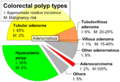 Pie chart of colorectal polyp etiologies
 -
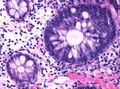 Non-proliferative versus proliferative colonic crypts
 -
 Histopathology of high-grade dysplasia in tubulovillous adenoma, annotated
 -
 Villous adenoma
 -
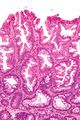 Sessile serrated adenoma, very high magnification


See Also[edit]
 | This medical article is a stub. You can help WikiMD by expanding the page. |
Sponsored Health Resource

W8MD Weight Loss, Sleep & MedSpa
Looking for physician-supervised weight loss, semaglutide, tirzepatide, or GLP-1 receptor agonist options? W8MD helps eligible patients in New York City, Brooklyn, New Jersey, Connecticut, Pennsylvania, Delaware, and greater Philadelphia with medical weight loss, sleep medicine, and long-term maintenance support.
GLP-1 specials: Affordable GLP-1 injections NYC and Philadelphia starting from $29.99/week and up for semaglutide with insurance accepted for qualifying visits, and $45/week and up for tirzepatide with insurance accepted for qualifying visits. Self-pay options start from $59.99/week and up for semaglutide and $69.99/week and up for tirzepatide.
Medical weight loss NYC | Affordable GLP-1 injections NYC | Budget GLP-1 weight loss shots Philadelphia | New Jersey medical weight loss | NYC medical weight loss | Philadelphia medical weight loss | Sleep clinic NYC | W8MD's Philadelphia GLP-1 doctor | Weight loss prescriptions NYC
Book a W8MD appointment · View GLP-1 specials
Paid promotional message. Eligibility, pricing, insurance coverage, medication availability, and results vary. Medical evaluation required.

Medical Disclaimer: WikiMD is for informational purposes only and is not a substitute for professional medical advice. Content may be inaccurate or outdated and should not be used for diagnosis or treatment. Always consult your healthcare provider for medical decisions. Verify information with trusted sources such as CDC.gov and NIH.gov. By using this site, you agree that WikiMD is not liable for any outcomes related to its content. See full disclaimer.
Credits:Most images are courtesy of Wikimedia commons, and templates, categories Wikipedia, licensed under CC BY SA or similar.
Translate page: - East Asian
中文,
日本,
한국어,
South Asian
हिन्दी,
தமிழ்,
తెలుగు,
Urdu,
ಕನ್ನಡ,
Southeast Asian
Indonesian,
Vietnamese,
Thai,
မြန်မာဘာသာ,
বাংলা
European
español,
Deutsch,
français,
Greek,
português do Brasil,
polski,
română,
русский,
Nederlands,
norsk,
svenska,
suomi,
Italian
Middle Eastern & African
عربى,
Turkish,
Persian,
Hebrew,
Afrikaans,
isiZulu,
Kiswahili,
Other
Bulgarian,
Hungarian,
Czech,
Swedish,
മലയാളം,
मराठी,
ਪੰਜਾਬੀ,
ગુજરાતી,
Portuguese,
Ukrainian

