Sunitinib
Information about Sunitinib[edit]
Sunitinib is multi-specific tyrosine kinase receptor inhibitor that is used in the therapy of gastrointestinal stromal tumors and advanced renal cell carcinoma.
Liver safety of Sunitinib[edit]
Sunitinib therapy is associated with transient elevations in serum aminotransferase and bilirubin levels and rare instances of clinically apparent acute liver injury.
Mechanism of action of Sunitinib[edit]
Sunitinib (soo ni' ti nib) is an inhibitor of several tyrosine kinase receptors which are associated with tumor growth and angiogenesis. The tyrosine kinase receptors of cancer cells are often mutated and can cause unregulated cell growth and proliferation. Sunitinib is one of several tyrosine kinase receptor inhibitors that have been introduced into cancer chemotherapy and are specially directed at molecular abnormalities that occur in cancer cells. Inhibition of the receptor can lead to dramatic reversal of progression the cancer, although sometimes limited by the development of tumor resistance caused by mutations in the kinase. Sunitinib has special activity against the abnormal tyrosine kinase (cKit) that is found in gastrointestinal stromal tumors (GIST). Sunitinib also has activity against the receptors for platelet derived growth factor (PDGF) and vascular endothelial growth factor (VEGF).
FDA approval information for Sunitinib[edit]
Sunitinib received approval for use in the United States in 2006. Current indications are for unresectable or metastatic GIST with positive cKit (CD117), advanced renal cell carcinoma and advanced pancreatic neuroendocrine tumors. Sunitinib is also used in patients who are intolerant or become resistant to imatinib, the initial tyrosine kinase receptor inhibitor that has special activity against chronic myelogenous leukemia (CML) bearing the Philadelphia chromosome.
Dosage and administration for Sunitinib[edit]
Sunitinib is available in capsules of 12.5, 25 and 50 mg under the brand name Sutent. The typical dose of sunitinib is in cycles of 4 weeks, followed by a rest period of 2 weeks, using a starting dose of 37.5 or 50 mg daily and increasing or decreasing in 12.5 mg increments, with each cycle based upon tolerance and response.
Side effects of Sunitinib[edit]
Side effects include fatigue, diarrhea, anorexia, skin discoloration, rash, hand-foot syndrome, edema, muscle cramps, arthralgias, headache, abdominal discomfort, anemia, cough, and pruritus. Uncommon side effects include heart failure, pancreatitis and renal failure.
Alphabetic list of antineoplastic agents - 0-9 - A1 - A2 - A3 - A4 - A5 -A6 - B - C - D - E - F - G - H - I - JK - L - M - NO - PQ - R - S - T - UVW - XYZ
| Antineoplastic Agents | ||||||||||
|---|---|---|---|---|---|---|---|---|---|---|
* Category
|
-
 Sunitinib
 -
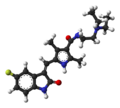 Sunitinib 3D balls


Sponsored Health Resource

W8MD Weight Loss, Sleep & MedSpa
Looking for physician-supervised weight loss, semaglutide, tirzepatide, or GLP-1 receptor agonist options? W8MD helps eligible patients in New York City, Brooklyn, New Jersey, Connecticut, Pennsylvania, Delaware, and greater Philadelphia with medical weight loss, sleep medicine, and long-term maintenance support.
GLP-1 specials: Affordable GLP-1 injections NYC and Philadelphia starting from $29.99/week and up for semaglutide with insurance accepted for qualifying visits, and $45/week and up for tirzepatide with insurance accepted for qualifying visits. Self-pay options start from $59.99/week and up for semaglutide and $69.99/week and up for tirzepatide.
Medical weight loss NYC | Affordable GLP-1 injections NYC | Budget GLP-1 weight loss shots Philadelphia | New Jersey medical weight loss | NYC medical weight loss | Philadelphia medical weight loss | Sleep clinic NYC | W8MD's Philadelphia GLP-1 doctor | Weight loss prescriptions NYC
Book a W8MD appointment · View GLP-1 specials
Paid promotional message. Eligibility, pricing, insurance coverage, medication availability, and results vary. Medical evaluation required.

Medical Disclaimer: WikiMD is for informational purposes only and is not a substitute for professional medical advice. Content may be inaccurate or outdated and should not be used for diagnosis or treatment. Always consult your healthcare provider for medical decisions. Verify information with trusted sources such as CDC.gov and NIH.gov. By using this site, you agree that WikiMD is not liable for any outcomes related to its content. See full disclaimer.
Credits:Most images are courtesy of Wikimedia commons, and templates, categories Wikipedia, licensed under CC BY SA or similar.
Translate page: - East Asian
中文,
日本,
한국어,
South Asian
हिन्दी,
தமிழ்,
తెలుగు,
Urdu,
ಕನ್ನಡ,
Southeast Asian
Indonesian,
Vietnamese,
Thai,
မြန်မာဘာသာ,
বাংলা
European
español,
Deutsch,
français,
Greek,
português do Brasil,
polski,
română,
русский,
Nederlands,
norsk,
svenska,
suomi,
Italian
Middle Eastern & African
عربى,
Turkish,
Persian,
Hebrew,
Afrikaans,
isiZulu,
Kiswahili,
Other
Bulgarian,
Hungarian,
Czech,
Swedish,
മലയാളം,
मराठी,
ਪੰਜਾਬੀ,
ગુજરાતી,
Portuguese,
Ukrainian

