Sulfur dichloride

Sulfur dichloride is a chemical compound with the formula SCl2. It is a toxic, red-brown liquid that is used in the manufacture of chemical compounds, particularly in the production of organosulfur compounds. Sulfur dichloride is an important reagent in chemistry, especially in synthetic chemistry, where it is used to introduce chlorine atoms into organic molecules.
Properties[edit]
Sulfur dichloride is characterized by its pungent odor and corrosive nature. It has a boiling point of 59 °C and a melting point of −121 °C. Being highly reactive, it readily hydrolyzes in water to form hydrochloric acid (HCl) and sulfur dioxide (SO2), which makes it hazardous to handle.
Production[edit]
The production of sulfur dichloride involves the direct chlorination of sulfur with chlorine gas at elevated temperatures. The reaction is exothermic and must be carefully controlled to prevent the formation of sulfur tetrachloride (SCl4), which is a less desirable byproduct.
Applications[edit]
Sulfur dichloride is primarily used in the synthesis of rubber chemicals, agricultural chemicals, and pharmaceuticals. It acts as a sulfurizing agent in the vulcanization process of rubber and as a chlorinating agent in the production of various organic compounds. Its ability to add sulfur and chlorine atoms to organic molecules makes it a valuable tool in the synthesis of a wide range of chemical products.
Safety[edit]
Due to its corrosive nature and the production of toxic gases upon contact with water, sulfur dichloride requires careful handling. Appropriate safety measures, including the use of personal protective equipment (PPE) and proper ventilation, are essential when working with this compound. Exposure to sulfur dichloride can cause severe burns to the skin and eyes, and inhalation of its vapors can lead to respiratory distress.
Environmental Impact[edit]
The release of sulfur dichloride into the environment can have harmful effects on aquatic life and air quality. Its breakdown products, including hydrochloric acid and sulfur dioxide, contribute to acid rain and air pollution. Therefore, the disposal of sulfur dichloride and its byproducts must be managed in accordance with environmental regulations to minimize its impact on the environment.
-
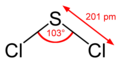 2D dimensions of Sulfur dichloride


Medical Disclaimer: WikiMD is for informational purposes only and is not a substitute for professional medical advice. Content may be inaccurate or outdated and should not be used for diagnosis or treatment. Always consult your healthcare provider for medical decisions. Verify information with trusted sources such as CDC.gov and NIH.gov. By using this site, you agree that WikiMD is not liable for any outcomes related to its content. See full disclaimer.
Credits:Most images are courtesy of Wikimedia commons, and templates, categories Wikipedia, licensed under CC BY SA or similar.
Translate page: - East Asian
中文,
日本,
한국어,
South Asian
हिन्दी,
தமிழ்,
తెలుగు,
Urdu,
ಕನ್ನಡ,
Southeast Asian
Indonesian,
Vietnamese,
Thai,
မြန်မာဘာသာ,
বাংলা
European
español,
Deutsch,
français,
Greek,
português do Brasil,
polski,
română,
русский,
Nederlands,
norsk,
svenska,
suomi,
Italian
Middle Eastern & African
عربى,
Turkish,
Persian,
Hebrew,
Afrikaans,
isiZulu,
Kiswahili,
Other
Bulgarian,
Hungarian,
Czech,
Swedish,
മലയാളം,
मराठी,
ਪੰਜਾਬੀ,
ગુજરાતી,
Portuguese,
Ukrainian

