Stuffed apples
Stuffed Apples are a popular dessert dish that originated in Europe, but have since spread worldwide. They are made by removing the core of an apple and filling the cavity with a mixture of ingredients such as cinnamon, sugar, and raisins. The apples are then baked until they are soft and the filling is hot and bubbly.
History[edit]
The concept of stuffing fruits and vegetables dates back to ancient times, but the specific practice of stuffing apples is believed to have originated in Europe during the Middle Ages. The dish was a popular way to make use of the abundant apple harvests in the fall and provided a sweet treat during the winter months.
Preparation[edit]
To prepare stuffed apples, the core of the apple is first removed, leaving a cavity in the center. This can be done with a corer or a small knife. The cavity is then filled with a mixture of ingredients. The most common filling is a combination of sugar, cinnamon, and raisins, but other ingredients such as nuts, oats, and butter can also be used. Once filled, the apples are placed in a baking dish and baked until they are soft and the filling is hot.
Variations[edit]
There are many variations of stuffed apples, with different regions having their own traditional recipes. In France, for example, the apples are often filled with Calvados (apple brandy) and cream. In the United States, a popular variation is to fill the apples with a mixture of brown sugar, oats, and butter, creating a dish that is similar to an apple crisp.
Serving[edit]
Stuffed apples are typically served warm, often with a scoop of vanilla ice cream or a dollop of whipped cream. They can be served as a dessert, but are also sometimes served as a side dish, particularly in the United States during the Thanksgiving holiday.
See also[edit]

-
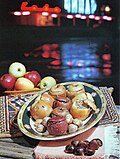 Stuffed apples


Medical Disclaimer: WikiMD is for informational purposes only and is not a substitute for professional medical advice. Content may be inaccurate or outdated and should not be used for diagnosis or treatment. Always consult your healthcare provider for medical decisions. Verify information with trusted sources such as CDC.gov and NIH.gov. By using this site, you agree that WikiMD is not liable for any outcomes related to its content. See full disclaimer.
Credits:Most images are courtesy of Wikimedia commons, and templates, categories Wikipedia, licensed under CC BY SA or similar.
Translate page: - East Asian
中文,
日本,
한국어,
South Asian
हिन्दी,
தமிழ்,
తెలుగు,
Urdu,
ಕನ್ನಡ,
Southeast Asian
Indonesian,
Vietnamese,
Thai,
မြန်မာဘာသာ,
বাংলা
European
español,
Deutsch,
français,
Greek,
português do Brasil,
polski,
română,
русский,
Nederlands,
norsk,
svenska,
suomi,
Italian
Middle Eastern & African
عربى,
Turkish,
Persian,
Hebrew,
Afrikaans,
isiZulu,
Kiswahili,
Other
Bulgarian,
Hungarian,
Czech,
Swedish,
മലയാളം,
मराठी,
ਪੰਜਾਬੀ,
ગુજરાતી,
Portuguese,
Ukrainian

