Epithelium
A type of tissue that lines the surfaces and cavities of organs and structures throughout the body
The epithelium is a type of tissue that forms the outer layer of the body's surfaces and lines the cavities and structures of organs. It serves as a protective barrier and is involved in absorption, secretion, and sensation. Epithelial tissue is one of the four main types of tissue in the body, alongside connective tissue, muscle tissue, and nervous tissue.
Structure[edit]
Epithelial cells are tightly packed together with minimal extracellular matrix, forming continuous sheets. These cells are connected by specialized junctions, such as tight junctions, adherens junctions, and desmosomes, which provide structural integrity and regulate the movement of substances between cells.
Types of Epithelium[edit]
Epithelial tissue is classified based on the number of cell layers and the shape of the cells on the surface:
- Simple epithelium: Consists of a single layer of cells. It is involved in processes such as absorption and filtration. Examples include:
 * Simple squamous epithelium: Thin and flat cells, found in areas like the alveoli of the lungs and the lining of blood vessels (endothelium).
 * Simple cuboidal epithelium: Cube-shaped cells, found in glandular tissues and in the kidney tubules.
 * Simple columnar epithelium: Tall, column-like cells, found in the digestive tract and the uterus.
- Stratified epithelium: Composed of multiple layers of cells, providing protection against abrasion. Examples include:
 * Stratified squamous epithelium: Found in areas subject to wear and tear, such as the skin, mouth, and esophagus.
 * Stratified cuboidal epithelium: Found in the ducts of some glands.
 * Stratified columnar epithelium: Rare, found in some parts of the pharynx and male urethra.
- Pseudostratified epithelium: Appears to be stratified but is actually a single layer with nuclei at different levels. Found in the respiratory tract, where it often contains cilia and goblet cells.
- Transitional epithelium: Specialized to stretch and is found in the urinary bladder and other parts of the urinary tract.
Functions[edit]
Epithelial tissue performs several critical functions:
- Protection: Acts as a barrier against mechanical injury, pathogens, and chemical exposure.
- Absorption: Facilitates the uptake of nutrients and other substances, particularly in the intestines.
- Secretion: Produces and releases substances such as enzymes, hormones, and mucus.
- Excretion: Removes waste products from the body.
- Sensation: Contains sensory nerve endings that respond to stimuli.
Location[edit]
Epithelial tissue is found throughout the body, covering surfaces and lining cavities. It forms the outer layer of the skin, lines the gastrointestinal tract, respiratory tract, reproductive tract, and urinary tract. It also forms the lining of blood vessels and lymphatic vessels.
Regeneration[edit]
Epithelial cells have a high capacity for regeneration due to their rapid turnover rate. This is essential for maintaining the integrity of the epithelial barrier and for healing after injury.
Related pages[edit]
Epithelium[edit]
-
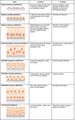 Summary of Epithelial Tissue Cells
 -
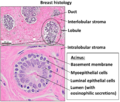 Normal Breast Histology
 -
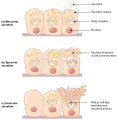 Modes of Secretion by Glands
 -
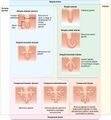 Types of Glands
 -
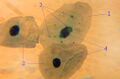 Chlamydia pneumoniae
 -
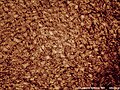 Dog Squamous 100x
 -
 Cheek Cells Stained
 -
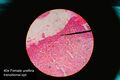 Female Urethra Histology
 -
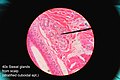 Sweat Gland Histology


Sponsored Health Resource

W8MD Weight Loss, Sleep & MedSpa
Looking for physician-supervised weight loss, semaglutide, tirzepatide, or GLP-1 receptor agonist options? W8MD helps eligible patients in New York City, Brooklyn, New Jersey, Connecticut, Pennsylvania, Delaware, and greater Philadelphia with medical weight loss, sleep medicine, and long-term maintenance support.
GLP-1 specials: Affordable GLP-1 injections NYC and Philadelphia starting from $29.99/week and up for semaglutide with insurance accepted for qualifying visits, and $45/week and up for tirzepatide with insurance accepted for qualifying visits. Self-pay options start from $59.99/week and up for semaglutide and $69.99/week and up for tirzepatide.
Medical weight loss NYC | Affordable GLP-1 injections NYC | Budget GLP-1 weight loss shots Philadelphia | New Jersey medical weight loss | NYC medical weight loss | Philadelphia medical weight loss | Sleep clinic NYC | W8MD's Philadelphia GLP-1 doctor | Weight loss prescriptions NYC
Book a W8MD appointment · View GLP-1 specials
Paid promotional message. Eligibility, pricing, insurance coverage, medication availability, and results vary. Medical evaluation required.

Medical Disclaimer: WikiMD is for informational purposes only and is not a substitute for professional medical advice. Content may be inaccurate or outdated and should not be used for diagnosis or treatment. Always consult your healthcare provider for medical decisions. Verify information with trusted sources such as CDC.gov and NIH.gov. By using this site, you agree that WikiMD is not liable for any outcomes related to its content. See full disclaimer.
Credits:Most images are courtesy of Wikimedia commons, and templates, categories Wikipedia, licensed under CC BY SA or similar.
Translate page: - East Asian
中文,
日本,
한국어,
South Asian
हिन्दी,
தமிழ்,
తెలుగు,
Urdu,
ಕನ್ನಡ,
Southeast Asian
Indonesian,
Vietnamese,
Thai,
မြန်မာဘာသာ,
বাংলা
European
español,
Deutsch,
français,
Greek,
português do Brasil,
polski,
română,
русский,
Nederlands,
norsk,
svenska,
suomi,
Italian
Middle Eastern & African
عربى,
Turkish,
Persian,
Hebrew,
Afrikaans,
isiZulu,
Kiswahili,
Other
Bulgarian,
Hungarian,
Czech,
Swedish,
മലയാളം,
मराठी,
ਪੰਜਾਬੀ,
ગુજરાતી,
Portuguese,
Ukrainian

