Sonoporation
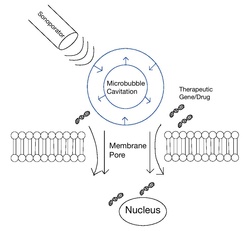

Sonoporation is a technique that uses ultrasound to temporarily create pores in the cell membrane, allowing for the delivery of therapeutic agents such as drugs, genes, or other molecules into the cell. This method is a form of mechanotransduction and is considered a non-invasive approach to enhance cellular uptake.
Mechanism[edit]
Sonoporation involves the application of ultrasound waves to cells, which induces the formation of transient pores in the cell membrane. The process is facilitated by the presence of microbubbles that oscillate and collapse under the influence of the ultrasound waves, creating mechanical forces that disrupt the cell membrane. The temporary pores allow for the entry of therapeutic agents into the cell before the membrane reseals.
Applications[edit]
Sonoporation has a wide range of applications in biomedicine and biotechnology. Some of the key applications include:
- Gene therapy: Facilitating the delivery of DNA or RNA into cells for the treatment of genetic disorders.
- Cancer treatment: Enhancing the uptake of chemotherapeutic drugs by cancer cells to improve treatment efficacy.
- Drug delivery: Increasing the intracellular concentration of drugs that are otherwise difficult to deliver.
- Vaccine development: Improving the delivery of antigens to immune cells to enhance the immune response.
Advantages[edit]
The advantages of sonoporation include:
- Non-invasiveness: Unlike other methods such as electroporation, sonoporation does not require direct physical contact with the cells.
- Targeted delivery: Ultrasound can be focused on specific tissues or cells, reducing off-target effects.
- Versatility: Can be used to deliver a wide range of therapeutic agents, including large molecules like proteins and nucleic acids.
Challenges[edit]
Despite its potential, sonoporation faces several challenges:
- Optimization: The parameters of ultrasound (frequency, intensity, duration) need to be carefully optimized to achieve effective and safe delivery.
- Cell viability: High-intensity ultrasound or prolonged exposure can cause cell damage or death.
- Standardization: Variability in experimental conditions can lead to inconsistent results, making it difficult to standardize protocols.
Future Directions[edit]
Research in sonoporation is ongoing, with efforts focused on improving the efficiency and safety of the technique. Advances in nanotechnology and microbubble engineering are expected to enhance the precision and effectiveness of sonoporation. Additionally, clinical trials are being conducted to evaluate the potential of sonoporation in various therapeutic applications.
See Also[edit]
References[edit]
 | This medical article is a stub. You can help WikiMD by expanding the page. |

Medical Disclaimer: WikiMD is for informational purposes only and is not a substitute for professional medical advice. Content may be inaccurate or outdated and should not be used for diagnosis or treatment. Always consult your healthcare provider for medical decisions. Verify information with trusted sources such as CDC.gov and NIH.gov. By using this site, you agree that WikiMD is not liable for any outcomes related to its content. See full disclaimer.
Credits:Most images are courtesy of Wikimedia commons, and templates, categories Wikipedia, licensed under CC BY SA or similar.
Translate page: - East Asian
中文,
日本,
한국어,
South Asian
हिन्दी,
தமிழ்,
తెలుగు,
Urdu,
ಕನ್ನಡ,
Southeast Asian
Indonesian,
Vietnamese,
Thai,
မြန်မာဘာသာ,
বাংলা
European
español,
Deutsch,
français,
Greek,
português do Brasil,
polski,
română,
русский,
Nederlands,
norsk,
svenska,
suomi,
Italian
Middle Eastern & African
عربى,
Turkish,
Persian,
Hebrew,
Afrikaans,
isiZulu,
Kiswahili,
Other
Bulgarian,
Hungarian,
Czech,
Swedish,
മലയാളം,
मराठी,
ਪੰਜਾਬੀ,
ગુજરાતી,
Portuguese,
Ukrainian

