Protein


A comprehensive overview of proteins, their structure, function, and importance in biological systems.
Proteins are large, complex molecules that play many critical roles in the body. They are essential for the structure, function, and regulation of the body's tissues and organs. Proteins are made up of hundreds or thousands of smaller units called amino acids, which are attached in long chains. There are 20 different types of amino acids that can be combined to make a protein.
Structure[edit]
Proteins are made up of one or more long chains of amino acids, which are called polypeptides. The sequence of amino acids determines each protein’s unique 3-dimensional structure and its specific function. Proteins can be classified into four levels of structure:
Primary Structure[edit]
The primary structure of a protein is its unique sequence of amino acids. This sequence is determined by the gene corresponding to the protein.
Secondary Structure[edit]
The secondary structure refers to local folded structures that form within a polypeptide due to interactions between atoms of the backbone. The most common types of secondary structures are the alpha helix and the beta pleated sheet.
Tertiary Structure[edit]
The tertiary structure is the overall three-dimensional structure of a polypeptide. It is determined by interactions among various side chains (R groups) of the amino acids.
Quaternary Structure[edit]
Some proteins are made up of multiple polypeptide chains, also known as subunits. The quaternary structure is the arrangement of these subunits in a multi-subunit complex.
Function[edit]
Proteins perform a vast array of functions within organisms, including:
- Enzymatic activity: Proteins that act as enzymes speed up chemical reactions in the body.
- Structural support: Proteins like collagen provide structural support to cells and tissues.
- Transport and storage: Proteins such as hemoglobin transport oxygen in the blood.
- Signaling: Proteins are involved in cell signaling and communication.
- Immune response: Antibodies are proteins that help protect the body from pathogens.
Synthesis[edit]
Protein synthesis is a complex process that involves transcription and translation. During transcription, a segment of DNA is copied into mRNA, which is then translated into a polypeptide chain at the ribosome.
Dietary Proteins[edit]
Proteins are an essential part of the diet. They provide the amino acids that the body cannot synthesize on its own. Dietary proteins can be found in both animal and plant sources, such as meat, fish, eggs, dairy products, legumes, and nuts.
Gallery of Protein and Peptide Structures[edit]
-
 Table of the genetic code showing codon-amino acid correspondence.
 -
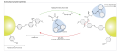 Diagram of peptide synthesis, illustrating step-by-step chemical formation of peptide bonds.
 -
Structure of a chaperonin protein that assists in the proper folding of other proteins.
-
Visualization of a protein’s tertiary structure, using PDB entry 1TIM as an example.
-
Composite image showing a variety of protein structural motifs and folding patterns.
-
Schematic showing domain organization in EVH proteins, involved in actin regulation.


Related pages[edit]
Sponsored Health Resource

W8MD Weight Loss, Sleep & MedSpa
Looking for physician-supervised weight loss, semaglutide, tirzepatide, or GLP-1 receptor agonist options? W8MD helps eligible patients in New York City, Brooklyn, New Jersey, Connecticut, Pennsylvania, Delaware, and greater Philadelphia with medical weight loss, sleep medicine, and long-term maintenance support.
GLP-1 specials: Affordable GLP-1 injections NYC and Philadelphia starting from $29.99/week and up for semaglutide with insurance accepted for qualifying visits, and $45/week and up for tirzepatide with insurance accepted for qualifying visits. Self-pay options start from $59.99/week and up for semaglutide and $69.99/week and up for tirzepatide.
- Medical weight loss NYC
- Affordable GLP-1 injections NYC
- Budget GLP-1 weight loss shots Philadelphia
- New Jersey medical weight loss
- NYC medical weight loss blog
- Philadelphia weight loss blog
- Sleep medicine and sleep apnea services
- W8MD MedSpa and wellness
Book a W8MD appointment · View GLP-1 specials
Paid promotional message. Eligibility, pricing, insurance coverage, medication availability, and results vary. Medical evaluation required.

Medical Disclaimer: WikiMD is for informational purposes only and is not a substitute for professional medical advice. Content may be inaccurate or outdated and should not be used for diagnosis or treatment. Always consult your healthcare provider for medical decisions. Verify information with trusted sources such as CDC.gov and NIH.gov. By using this site, you agree that WikiMD is not liable for any outcomes related to its content. See full disclaimer.
Credits:Most images are courtesy of Wikimedia commons, and templates, categories Wikipedia, licensed under CC BY SA or similar.
Translate page: - East Asian
中文,
日本,
한국어,
South Asian
हिन्दी,
தமிழ்,
తెలుగు,
Urdu,
ಕನ್ನಡ,
Southeast Asian
Indonesian,
Vietnamese,
Thai,
မြန်မာဘာသာ,
বাংলা
European
español,
Deutsch,
français,
Greek,
português do Brasil,
polski,
română,
русский,
Nederlands,
norsk,
svenska,
suomi,
Italian
Middle Eastern & African
عربى,
Turkish,
Persian,
Hebrew,
Afrikaans,
isiZulu,
Kiswahili,
Other
Bulgarian,
Hungarian,
Czech,
Swedish,
മലയാളം,
मराठी,
ਪੰਜਾਬੀ,
ગુજરાતી,
Portuguese,
Ukrainian


