R-process

The r-process, or rapid neutron-capture process, is one of the primary processes by which heavy elements (those heavier than iron) are synthesized in the universe. The r-process involves the rapid absorption of neutrons by a nucleus, followed by beta decay (the transformation of a neutron into a proton, with the emission of an electron and an antineutrino). This process occurs in environments with a high density of free neutrons and is responsible for the creation of approximately half of the atomic nuclei heavier than iron, including many isotopes of heavy elements found on Earth.
Overview[edit]
The r-process is distinguished from the s-process, or slow neutron-capture process, by the rate at which neutrons are captured by nuclei. In the r-process, nuclei capture neutrons rapidly, before they can decay, leading to the creation of very neutron-rich isotopes. These isotopes then undergo beta decay to become more stable, heavier elements. The r-process is believed to occur in extreme astrophysical environments where there are enough free neutrons and high temperatures, such as those found in supernova explosions or the mergers of neutron stars.
Astrophysical Sites[edit]
The exact sites of the r-process have been a subject of research and debate among astrophysicists. Historically, core-collapse supernovae were considered the primary site for the r-process. However, recent observations and models suggest that neutron star mergers might play a significant, if not dominant, role in the production of r-process elements. These mergers can produce the necessary conditions for the r-process, including extremely high temperatures, densities, and an abundance of neutrons.
Importance in the Universe[edit]
The elements produced by the r-process are crucial for understanding the chemical evolution of the galaxy and the composition of the solar system. Many of these elements, such as uranium, thorium, and platinum, are essential for various technological applications on Earth. Additionally, the distribution and abundance of r-process elements observed in ancient stars provide insights into the history of stellar formation and the synthesis of elements in the early universe.
Research and Observation[edit]
Advancements in astronomy and astrophysics have allowed scientists to observe the signatures of r-process elements in stars and nebulae, as well as in the aftermath of neutron star mergers. These observations, combined with theoretical models, help researchers understand the conditions under which the r-process occurs and its role in the cosmic cycle of matter.
Challenges and Future Directions[edit]
Despite significant progress, many questions about the r-process remain. The precise conditions required for the r-process, the relative contributions of different astrophysical sites, and the complete list of elements produced are still under investigation. Future observations, particularly with next-generation telescopes and gravitational wave detectors, are expected to provide deeper insights into the r-process and its role in the cosmos.
 | This physics-related article is a stub. You can help WikiMD by expanding the page. |
-
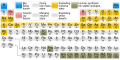 Nucleosynthesis periodic table


Medical Disclaimer: WikiMD is for informational purposes only and is not a substitute for professional medical advice. Content may be inaccurate or outdated and should not be used for diagnosis or treatment. Always consult your healthcare provider for medical decisions. Verify information with trusted sources such as CDC.gov and NIH.gov. By using this site, you agree that WikiMD is not liable for any outcomes related to its content. See full disclaimer.
Credits:Most images are courtesy of Wikimedia commons, and templates, categories Wikipedia, licensed under CC BY SA or similar.
Translate page: - East Asian
中文,
日本,
한국어,
South Asian
हिन्दी,
தமிழ்,
తెలుగు,
Urdu,
ಕನ್ನಡ,
Southeast Asian
Indonesian,
Vietnamese,
Thai,
မြန်မာဘာသာ,
বাংলা
European
español,
Deutsch,
français,
Greek,
português do Brasil,
polski,
română,
русский,
Nederlands,
norsk,
svenska,
suomi,
Italian
Middle Eastern & African
عربى,
Turkish,
Persian,
Hebrew,
Afrikaans,
isiZulu,
Kiswahili,
Other
Bulgarian,
Hungarian,
Czech,
Swedish,
മലയാളം,
मराठी,
ਪੰਜਾਬੀ,
ગુજરાતી,
Portuguese,
Ukrainian

