Purkinje fibers
Purkinje fibers are specialized cardiac muscle cells in the heart that play a crucial role in the heart's electrical conduction system. They are named after the Czech anatomist Jan Evangelista Purkyně, who discovered them in 1839.
Structure[edit]
Purkinje fibers are located in the inner ventricular walls of the heart, just beneath the endocardium. These fibers are specialized myocardial cells that are larger than regular cardiac muscle cells, with fewer myofibrils and a large amount of glycogen. They also have a single, centrally located nucleus.
Function[edit]
The primary role of Purkinje fibers is to conduct electrical impulses from the atrioventricular node (AV node) to the ventricles of the heart. This rapid conduction of impulses allows the heart to contract in a coordinated manner, ensuring efficient pumping of blood throughout the body.
Clinical significance[edit]
Abnormalities in the Purkinje fibers can lead to various types of cardiac arrhythmias. For instance, damage to these fibers can result in bundle branch block, where the electrical impulse is delayed or blocked before it reaches the ventricles. This can lead to a slow or irregular heartbeat, known as bradycardia or tachycardia, respectively.
See also[edit]
References[edit]
<references />
 | This medical article is a stub. You can help WikiMD by expanding the page. |
-
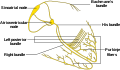 Diagram of the heart's conduction system
 -
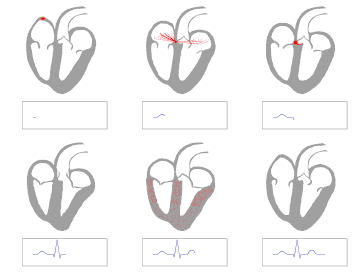 Principle of ECG
 -
 Histology of endocardium and subendocardium


Medical Disclaimer: WikiMD is for informational purposes only and is not a substitute for professional medical advice. Content may be inaccurate or outdated and should not be used for diagnosis or treatment. Always consult your healthcare provider for medical decisions. Verify information with trusted sources such as CDC.gov and NIH.gov. By using this site, you agree that WikiMD is not liable for any outcomes related to its content. See full disclaimer.
Credits:Most images are courtesy of Wikimedia commons, and templates, categories Wikipedia, licensed under CC BY SA or similar.
Translate this page: - East Asian
中文,
日本,
한국어,
South Asian
हिन्दी,
தமிழ்,
తెలుగు,
Urdu,
ಕನ್ನಡ,
Southeast Asian
Indonesian,
Vietnamese,
Thai,
မြန်မာဘာသာ,
বাংলা
European
español,
Deutsch,
français,
Greek,
português do Brasil,
polski,
română,
русский,
Nederlands,
norsk,
svenska,
suomi,
Italian
Middle Eastern & African
عربى,
Turkish,
Persian,
Hebrew,
Afrikaans,
isiZulu,
Kiswahili,
Other
Bulgarian,
Hungarian,
Czech,
Swedish,
മലയാളം,
मराठी,
ਪੰਜਾਬੀ,
ગુજરાતી,
Portuguese,
Ukrainian
