Endocardium
Endocardium is the innermost layer of tissue that lines the chambers of the heart. Its cells are embryologically and biologically similar to the endothelial cells that line blood vessels. The endocardium also provides a smooth lining for the chambers of the heart and the valves, facilitating the flow of blood within the heart.
Structure[edit]
The endocardium is a thin layer of endothelial cells, which are in direct contact with the blood that the heart pumps. It is continuous with the endothelial lining of the large blood vessels attached to the heart, such as the aorta and the pulmonary artery. The endocardium is separated from the underlying myocardium (the muscular tissue of the heart) by a layer of connective tissue.
Function[edit]
The endocardium plays a crucial role in the function of the heart. It provides a smooth surface that minimizes friction as blood flows through the heart. It also plays a role in the regulation of the contraction of the heart muscle, the myocardium. The endocardium is involved in the formation of heart valves, which prevent the backflow of blood within the heart.
Clinical significance[edit]
Damage to the endocardium can lead to a number of heart conditions. For example, endocarditis is an inflammation of the endocardium, often caused by infection. This can lead to serious complications, including heart failure and stroke. Other conditions that can affect the endocardium include cardiomyopathy and heart valve disease.
See also[edit]
References[edit]

This WikiMD article can only be edited by registered and verified editors. You can log in or register.
Endocardium[edit]
-
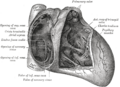 Endocardium
 -
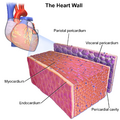 Heart wall structure
 -
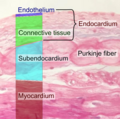 Endocardium and subendocardium histology


Medical Disclaimer: WikiMD is for informational purposes only and is not a substitute for professional medical advice. Content may be inaccurate or outdated and should not be used for diagnosis or treatment. Always consult your healthcare provider for medical decisions. Verify information with trusted sources such as CDC.gov and NIH.gov. By using this site, you agree that WikiMD is not liable for any outcomes related to its content. See full disclaimer.
Credits:Most images are courtesy of Wikimedia commons, and templates, categories Wikipedia, licensed under CC BY SA or similar.
Translate page: - East Asian
中文,
日本,
한국어,
South Asian
हिन्दी,
தமிழ்,
తెలుగు,
Urdu,
ಕನ್ನಡ,
Southeast Asian
Indonesian,
Vietnamese,
Thai,
မြန်မာဘာသာ,
বাংলা
European
español,
Deutsch,
français,
Greek,
português do Brasil,
polski,
română,
русский,
Nederlands,
norsk,
svenska,
suomi,
Italian
Middle Eastern & African
عربى,
Turkish,
Persian,
Hebrew,
Afrikaans,
isiZulu,
Kiswahili,
Other
Bulgarian,
Hungarian,
Czech,
Swedish,
മലയാളം,
मराठी,
ਪੰਜਾਬੀ,
ગુજરાતી,
Portuguese,
Ukrainian

