Pomace
Pomace or marc is a solid byproduct of the winemaking process. It is derived from the pulp, skins, stems, and seeds of grapes after the juice has been extracted for wine production. Pomace has been used in various ways throughout history and across cultures, including as a fertilizer, a source of biofuel, and a component in the production of certain types of brandy and grappa.
History[edit]
The use of pomace dates back to ancient times. The Romans and Greeks used pomace as a fertilizer, recognizing its rich nutrient content. In more recent times, pomace has been used in the production of pomace brandy, a type of brandy made from the fermented pomace.
Composition[edit]
Pomace is composed of the skins, pulp, seeds, and stems of grapes. The exact composition can vary depending on the type of grape and the winemaking process. Generally, pomace is rich in fiber, antioxidants, and polyphenols, which are beneficial compounds found in plants.
Uses[edit]
Winemaking[edit]
In winemaking, pomace is often used to produce a second, less expensive wine known as pomace wine or vin de piquette. This is made by soaking the pomace in water and fermenting it a second time.
Distillation[edit]
Pomace can also be distilled to produce a type of brandy known as pomace brandy or marc. This is a common practice in countries such as Italy, where it is known as grappa, and France, where it is known as marc de Bourgogne.
Fertilizer[edit]
Due to its rich nutrient content, pomace has been used as a fertilizer for centuries. It can be composted and used to enrich soil, promoting plant growth.
Biofuel[edit]
More recently, pomace has been explored as a potential source of biofuel. The high sugar content in the grape skins and pulp can be fermented to produce ethanol, a type of biofuel.
See also[edit]

-
 Pomace
 -
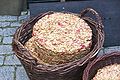 Apple pressings
 -
 Handful of Barossa Valley white grape marc
 -
 Handful of Barossa Valley red grape marc


Medical Disclaimer: WikiMD is for informational purposes only and is not a substitute for professional medical advice. Content may be inaccurate or outdated and should not be used for diagnosis or treatment. Always consult your healthcare provider for medical decisions. Verify information with trusted sources such as CDC.gov and NIH.gov. By using this site, you agree that WikiMD is not liable for any outcomes related to its content. See full disclaimer.
Credits:Most images are courtesy of Wikimedia commons, and templates, categories Wikipedia, licensed under CC BY SA or similar.
Translate this page: - East Asian
中文,
日本,
한국어,
South Asian
हिन्दी,
தமிழ்,
తెలుగు,
Urdu,
ಕನ್ನಡ,
Southeast Asian
Indonesian,
Vietnamese,
Thai,
မြန်မာဘာသာ,
বাংলা
European
español,
Deutsch,
français,
Greek,
português do Brasil,
polski,
română,
русский,
Nederlands,
norsk,
svenska,
suomi,
Italian
Middle Eastern & African
عربى,
Turkish,
Persian,
Hebrew,
Afrikaans,
isiZulu,
Kiswahili,
Other
Bulgarian,
Hungarian,
Czech,
Swedish,
മലയാളം,
मराठी,
ਪੰਜਾਬੀ,
ગુજરાતી,
Portuguese,
Ukrainian
