Polyanhydride
Polyanhydrides are a class of biodegradable polymers characterized by anhydride bonds that connect the monomer units. They are synthesized primarily from the condensation of an acid anhydride and a dicarboxylic acid. Due to their biodegradability, polyanhydrides have garnered significant interest for use in medical applications, particularly in the development of drug delivery systems and biomedical engineering.
History[edit]
Polyanhydrides were first studied in the late 20th century as materials for controlled drug release. Their degradation into biocompatible by-products makes them particularly suitable for biomedical applications. Over the years, research has expanded into various types of polyanhydrides, exploring their potential in different medical fields.
Chemistry[edit]
The chemical structure of polyanhydrides consists of repeating units linked by anhydride bonds. This structure is responsible for the polymer's biodegradability, as the anhydride bonds are susceptible to hydrolysis, leading to the polymer's breakdown. The rate of degradation can be controlled by altering the polymer's chemical composition, making polyanhydrides versatile materials for drug delivery systems.
Applications[edit]
Drug Delivery Systems[edit]
Polyanhydrides are extensively used in the development of drug delivery systems. Their biodegradability allows for the controlled release of drugs, making them ideal for targeting specific sites within the body over extended periods. This property is particularly beneficial for treating chronic conditions, where consistent drug levels are necessary.
Biomedical Engineering[edit]
In biomedical engineering, polyanhydrides are used in the fabrication of implants and tissue engineering scaffolds. Their biocompatibility and degradation rate can be tailored to match the requirements of the application, whether it be temporary support structures or vehicles for localized drug delivery.
Advantages[edit]
Polyanhydrides offer several advantages in medical applications, including:
- Controlled degradation rate
- Biocompatibility
- Ability to deliver a wide range of drugs
- Versatility in applications ranging from drug delivery to tissue engineering
Challenges[edit]
Despite their benefits, the use of polyanhydrides faces challenges, such as:
- Limited mechanical strength, which can restrict their use in load-bearing applications
- Potential for acidic by-products during degradation, which may require careful consideration in certain biomedical applications
Future Directions[edit]
Research into polyanhydrides continues to evolve, with ongoing studies aimed at improving their properties and expanding their applications. Innovations in polymer chemistry are expected to address current limitations and open new avenues for their use in medicine.
-
 Polyanhydride Structure
 -
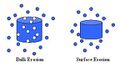 Bulk vs Surface Erosion


Sponsored Health Resource

W8MD Weight Loss, Sleep & MedSpa
Looking for physician-supervised weight loss, semaglutide, tirzepatide, or GLP-1 receptor agonist options? W8MD helps eligible patients in New York City, Brooklyn, New Jersey, Connecticut, Pennsylvania, Delaware, and greater Philadelphia with medical weight loss, sleep medicine, and long-term maintenance support.
GLP-1 specials: Affordable GLP-1 injections NYC and Philadelphia starting from $29.99/week and up for semaglutide with insurance accepted for qualifying visits, and $45/week and up for tirzepatide with insurance accepted for qualifying visits. Self-pay options start from $59.99/week and up for semaglutide and $69.99/week and up for tirzepatide.
Medical weight loss NYC | Affordable GLP-1 injections NYC | Budget GLP-1 weight loss shots Philadelphia | New Jersey medical weight loss | NYC medical weight loss | Philadelphia medical weight loss | Sleep clinic NYC | W8MD's Philadelphia GLP-1 doctor | Weight loss prescriptions NYC
Book a W8MD appointment · View GLP-1 specials
Paid promotional message. Eligibility, pricing, insurance coverage, medication availability, and results vary. Medical evaluation required.

Medical Disclaimer: WikiMD is for informational purposes only and is not a substitute for professional medical advice. Content may be inaccurate or outdated and should not be used for diagnosis or treatment. Always consult your healthcare provider for medical decisions. Verify information with trusted sources such as CDC.gov and NIH.gov. By using this site, you agree that WikiMD is not liable for any outcomes related to its content. See full disclaimer.
Credits:Most images are courtesy of Wikimedia commons, and templates, categories Wikipedia, licensed under CC BY SA or similar.
Translate page: - East Asian
中文,
日本,
한국어,
South Asian
हिन्दी,
தமிழ்,
తెలుగు,
Urdu,
ಕನ್ನಡ,
Southeast Asian
Indonesian,
Vietnamese,
Thai,
မြန်မာဘာသာ,
বাংলা
European
español,
Deutsch,
français,
Greek,
português do Brasil,
polski,
română,
русский,
Nederlands,
norsk,
svenska,
suomi,
Italian
Middle Eastern & African
عربى,
Turkish,
Persian,
Hebrew,
Afrikaans,
isiZulu,
Kiswahili,
Other
Bulgarian,
Hungarian,
Czech,
Swedish,
മലയാളം,
मराठी,
ਪੰਜਾਬੀ,
ગુજરાતી,
Portuguese,
Ukrainian

