Papillary tumor
A papillary tumor is a type of neoplasm that has a characteristic papillary architecture. The term "papillary" refers to the tumor's growth pattern, which resembles small, finger-like projections or papillae. Papillary tumors can occur in various parts of the body, including the thyroid gland, kidneys, bladder, and breast.
Characteristics[edit]
Papillary tumors are typically characterized by their distinct papillary structures. These structures are formed by proliferating cells that create a fibrovascular core, which is then covered by a layer of neoplastic cells. The presence of these papillary structures is a key factor in the diagnosis of papillary tumors.
Types of Papillary Tumors[edit]
Papillary Thyroid Carcinoma[edit]
Papillary thyroid carcinoma is the most common type of thyroid cancer. It is typically slow-growing and often presents as a painless mass in the neck.
Papillary Renal Cell Carcinoma[edit]
Papillary renal cell carcinoma is a type of kidney cancer that arises from the renal tubular epithelium. It is the second most common type of renal cell carcinoma.
Papillary Urothelial Carcinoma[edit]
Papillary urothelial carcinoma is a type of bladder cancer that originates from the urothelial lining of the bladder. It is characterized by the presence of papillary structures on the surface of the tumor.
Papillary Breast Cancer[edit]
Papillary breast cancer is a rare type of breast cancer that is characterized by the presence of papillary structures. It is typically less aggressive than other types of breast cancer.
Diagnosis and Treatment[edit]
The diagnosis of a papillary tumor typically involves a combination of medical imaging, biopsy, and histopathology. Treatment options for papillary tumors depend on the location and stage of the tumor, and may include surgery, radiation therapy, and chemotherapy.
See Also[edit]
 | This medical article is a stub. You can help WikiMD by expanding the page. |
 | This oncology article is a stub. You can help WikiMD by expanding the page. |
_histopatholgy.jpg) | This article related to pathology is a stub. You can help WikiMD by expanding the page. |
Papillary_tumor[edit]
-
Thyroid papillary carcinoma
-
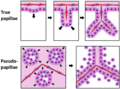 Papillae vs pseudopapillae


Medical Disclaimer: WikiMD is for informational purposes only and is not a substitute for professional medical advice. Content may be inaccurate or outdated and should not be used for diagnosis or treatment. Always consult your healthcare provider for medical decisions. Verify information with trusted sources such as CDC.gov and NIH.gov. By using this site, you agree that WikiMD is not liable for any outcomes related to its content. See full disclaimer.
Credits:Most images are courtesy of Wikimedia commons, and templates, categories Wikipedia, licensed under CC BY SA or similar.
Translate page: - East Asian
中文,
日本,
한국어,
South Asian
हिन्दी,
தமிழ்,
తెలుగు,
Urdu,
ಕನ್ನಡ,
Southeast Asian
Indonesian,
Vietnamese,
Thai,
မြန်မာဘာသာ,
বাংলা
European
español,
Deutsch,
français,
Greek,
português do Brasil,
polski,
română,
русский,
Nederlands,
norsk,
svenska,
suomi,
Italian
Middle Eastern & African
عربى,
Turkish,
Persian,
Hebrew,
Afrikaans,
isiZulu,
Kiswahili,
Other
Bulgarian,
Hungarian,
Czech,
Swedish,
മലയാളം,
मराठी,
ਪੰਜਾਬੀ,
ગુજરાતી,
Portuguese,
Ukrainian


