P-type calcium channel
P-type calcium channel is a type of voltage-gated calcium channel that plays a crucial role in neuronal function. Named for their purification from Purkinje cells, P-type calcium channels are found in the brain and other tissues, where they contribute to the regulation of calcium levels and participate in various cellular processes.
Function[edit]
P-type calcium channels are activated by changes in the membrane potential and allow the passage of calcium ions into the cell. This influx of calcium triggers a variety of cellular responses, including neurotransmitter release, muscle contraction, and gene expression. In neurons, P-type calcium channels are particularly important for the initiation of action potentials and the propagation of electrical signals.
Structure[edit]
Like other voltage-gated calcium channels, P-type calcium channels are composed of several subunits. The main, or α1, subunit forms the pore through which calcium ions pass and is responsible for the channel's voltage-sensing properties. Other subunits, including the β, γ, and δ subunits, modulate the channel's function and help anchor it in the cell membrane.
Clinical significance[edit]
Mutations in the genes encoding P-type calcium channels can lead to a variety of neurological disorders. For example, mutations in the CACNA1A gene, which encodes the α1 subunit of the P/Q-type calcium channel (a subtype of P-type calcium channel), have been associated with Familial Hemiplegic Migraine, Episodic Ataxia Type 2, and Spinocerebellar Ataxia Type 6.
See also[edit]
References[edit]
 | This neuroscience article is a stub. You can help WikiMD by expanding the page. |
-
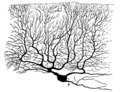 Stained Purkinje cell from a human cerebellum
 -
 Agelenidae spider in Los Angeles
 -
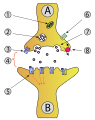 Diagram of a synapse


Medical Disclaimer: WikiMD is for informational purposes only and is not a substitute for professional medical advice. Content may be inaccurate or outdated and should not be used for diagnosis or treatment. Always consult your healthcare provider for medical decisions. Verify information with trusted sources such as CDC.gov and NIH.gov. By using this site, you agree that WikiMD is not liable for any outcomes related to its content. See full disclaimer.
Credits:Most images are courtesy of Wikimedia commons, and templates, categories Wikipedia, licensed under CC BY SA or similar.
Translate page: - East Asian
中文,
日本,
한국어,
South Asian
हिन्दी,
தமிழ்,
తెలుగు,
Urdu,
ಕನ್ನಡ,
Southeast Asian
Indonesian,
Vietnamese,
Thai,
မြန်မာဘာသာ,
বাংলা
European
español,
Deutsch,
français,
Greek,
português do Brasil,
polski,
română,
русский,
Nederlands,
norsk,
svenska,
suomi,
Italian
Middle Eastern & African
عربى,
Turkish,
Persian,
Hebrew,
Afrikaans,
isiZulu,
Kiswahili,
Other
Bulgarian,
Hungarian,
Czech,
Swedish,
മലയാളം,
मराठी,
ਪੰਜਾਬੀ,
ગુજરાતી,
Portuguese,
Ukrainian

