Nigrostriatal pathway
Nigrostriatal pathway is a neural pathway that connects the substantia nigra with the dorsal striatum. It is one of the four major dopamine pathways in the brain, and is particularly involved in the production of movement, as part of a system called the basal ganglia motor loop.
Etymology[edit]
The term "nigrostriatal" is derived from two Latin words: "nigro", meaning black, and "striatal", referring to the striatum. The substantia nigra is so named because it appears darker than most other brain areas due to high levels of neuromelanin in dopaminergic neurons. The striatum is named for its striped (striated) appearance of gray and white matter.
Anatomy[edit]
The nigrostriatal pathway is composed of dopaminergic neurons that originate in the substantia nigra pars compacta (SNc) and project to the dorsal striatum (i.e., the caudate nucleus and the putamen). The striatum also receives input from other parts of the brain, including the cortex and the thalamus.
Function[edit]
The nigrostriatal pathway is primarily involved in the regulation of voluntary movement. It is also implicated in reward, reinforcement learning, and habit formation. Dopamine released from the nigrostriatal pathway into the striatum modulates the activity of striatal neurons and influences the output of the basal ganglia motor loop.
Clinical significance[edit]
Damage to the nigrostriatal pathway is a major feature of Parkinson's disease, a neurodegenerative disorder characterized by movement problems such as tremor, rigidity, bradykinesia (slowness of movement), and postural instability. The loss of dopaminergic neurons in the substantia nigra and the consequent reduction of dopamine release in the striatum is thought to be the primary cause of the motor symptoms of Parkinson's disease.
See also[edit]
References[edit]

This WikiMD article can only be edited by registered and verified editors. You can log in or register.
-
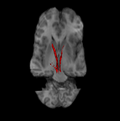 Nigrostriatal tract
 -
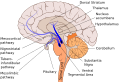 Nigrostriatal pathway
 -
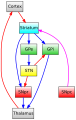 Basal ganglia diagram


Medical Disclaimer: WikiMD is for informational purposes only and is not a substitute for professional medical advice. Content may be inaccurate or outdated and should not be used for diagnosis or treatment. Always consult your healthcare provider for medical decisions. Verify information with trusted sources such as CDC.gov and NIH.gov. By using this site, you agree that WikiMD is not liable for any outcomes related to its content. See full disclaimer.
Credits:Most images are courtesy of Wikimedia commons, and templates, categories Wikipedia, licensed under CC BY SA or similar.
Translate page: - East Asian
中文,
日本,
한국어,
South Asian
हिन्दी,
தமிழ்,
తెలుగు,
Urdu,
ಕನ್ನಡ,
Southeast Asian
Indonesian,
Vietnamese,
Thai,
မြန်မာဘာသာ,
বাংলা
European
español,
Deutsch,
français,
Greek,
português do Brasil,
polski,
română,
русский,
Nederlands,
norsk,
svenska,
suomi,
Italian
Middle Eastern & African
عربى,
Turkish,
Persian,
Hebrew,
Afrikaans,
isiZulu,
Kiswahili,
Other
Bulgarian,
Hungarian,
Czech,
Swedish,
മലയാളം,
मराठी,
ਪੰਜਾਬੀ,
ગુજરાતી,
Portuguese,
Ukrainian

