Nazi Germany
Nazi Germany, officially known as the German Reich from 1933 to 1943 and Greater German Reich from 1943 to 1945, was a period in German history where the country was under the dictatorship of Adolf Hitler and the National Socialist German Workers' Party (NSDAP), commonly known as the Nazi Party.
Ideology[edit]
The ideology of Nazi Germany was a combination of political nationalism, racism, and eugenics, which was expressed in the party's full name, the National Socialist German Workers' Party. The ideology was a form of fascism, with elements of antisemitism, anti-communism, and totalitarianism.
Rise to Power[edit]
The Nazi Party's rise to power began in the early 1920s, following the aftermath of World War I. The party gained popularity through its opposition to the Treaty of Versailles, which many Germans felt was unfair. Hitler became the party's leader in 1921 and began his pursuit of establishing a new order in Germany.
Government and Politics[edit]
The government of Nazi Germany was a dictatorship, with Hitler as the Führer, or leader. The government was characterized by centralization of power, suppression of dissent, and widespread surveillance and propaganda.
Economy[edit]
The economy of Nazi Germany was a mixed economy, with both private and state ownership. The government implemented policies of autarky, or economic self-sufficiency, and launched massive public works programs to combat unemployment.
Society and Culture[edit]
Society and culture in Nazi Germany were heavily influenced by the party's ideology. The government controlled all aspects of life, including education, the arts, and the media. The regime promoted a cult of personality around Hitler and propagated the idea of racial purity.
World War II and the Holocaust[edit]
Nazi Germany played a central role in initiating World War II with the invasion of Poland in 1939. The regime also implemented the Final Solution, a plan to exterminate the Jewish population in Europe, resulting in the Holocaust.
Legacy[edit]
The legacy of Nazi Germany is one of the most studied and debated topics in modern history. The regime's policies and actions have had a profound impact on the world, leading to a reevaluation of ethical standards and the establishment of international laws against genocide and crimes against humanity.
 | This Germany-related article is a stub. You can help WikiMD by expanding the page. |
 | This article related to the Holocaust is a stub. You can help WikiMD by expanding the page. |
-
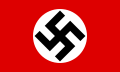 Flag of the NSDAP (1920–1945)
 -
 German Reich 1942 Greatest Extend, end of 1942
 -
 NS administrative Gliederung 1944
 -
 Hitler portrait
 -
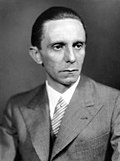 Joseph Goebbels
 -
 Wien, Heldenplatz, Rede Adolf Hitler
 -
 Anschluss sudetendeutscher Gebiete
 -
 Second world war europe animation
 -
 World War II in Europe, 1942
 -
 Paris, Avenue Foch, Siegesparade
.svg)


Medical Disclaimer: WikiMD is for informational purposes only and is not a substitute for professional medical advice. Content may be inaccurate or outdated and should not be used for diagnosis or treatment. Always consult your healthcare provider for medical decisions. Verify information with trusted sources such as CDC.gov and NIH.gov. By using this site, you agree that WikiMD is not liable for any outcomes related to its content. See full disclaimer.
Credits:Most images are courtesy of Wikimedia commons, and templates, categories Wikipedia, licensed under CC BY SA or similar.
Translate this page: - East Asian
中文,
日本,
한국어,
South Asian
हिन्दी,
தமிழ்,
తెలుగు,
Urdu,
ಕನ್ನಡ,
Southeast Asian
Indonesian,
Vietnamese,
Thai,
မြန်မာဘာသာ,
বাংলা
European
español,
Deutsch,
français,
Greek,
português do Brasil,
polski,
română,
русский,
Nederlands,
norsk,
svenska,
suomi,
Italian
Middle Eastern & African
عربى,
Turkish,
Persian,
Hebrew,
Afrikaans,
isiZulu,
Kiswahili,
Other
Bulgarian,
Hungarian,
Czech,
Swedish,
മലയാളം,
मराठी,
ਪੰਜਾਬੀ,
ગુજરાતી,
Portuguese,
Ukrainian
