Naive B cell
Naive B cells are a type of B cell that have not yet been activated by an antigen. They are part of the adaptive immune system and play a crucial role in the body's defense against pathogens.
Overview[edit]
Naive B cells are produced in the bone marrow and then migrate to the lymph nodes and spleen, where they wait to encounter their specific antigen. They are called "naive" because they have not yet encountered the antigen they are programmed to recognize.
When a naive B cell encounters its specific antigen, it becomes activated and differentiates into either a plasma cell or a memory B cell. Plasma cells produce antibodies that can neutralize the antigen, while memory B cells provide long-term immunity by remembering the antigen and responding more quickly upon future encounters.
Function[edit]
The primary function of naive B cells is to recognize antigens. Each naive B cell has a unique B cell receptor (BCR) on its surface that can bind to a specific antigen. The BCR is essentially an antibody molecule that is anchored in the B cell membrane.
When the BCR binds to its specific antigen, the B cell internalizes the antigen and presents fragments of it on its surface in combination with Major Histocompatibility Complex (MHC) class II molecules. This process is known as antigen presentation.
The presented antigen fragments can then be recognized by T helper cells, which provide the necessary signals for B cell activation and differentiation.
Activation and Differentiation[edit]
Upon activation, naive B cells undergo a process of clonal expansion, where they rapidly divide and differentiate into plasma cells and memory B cells.
Plasma cells are the body's antibody factories. They produce large amounts of antibodies that are released into the bloodstream to neutralize the antigen.
Memory B cells, on the other hand, do not produce antibodies immediately. Instead, they provide long-term immunity by remembering the antigen and responding more quickly and effectively upon future encounters.
Clinical Significance[edit]
Naive B cells are of clinical significance in many diseases, including autoimmune diseases, allergies, and infections. They are also important in vaccine development, as vaccines aim to stimulate the production of memory B cells that can provide long-term protection against specific pathogens.
 | This immunology article is a stub. You can help WikiMD by expanding the page. |
-
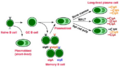 B cell activation naive to plasma cell


Medical Disclaimer: WikiMD is for informational purposes only and is not a substitute for professional medical advice. Content may be inaccurate or outdated and should not be used for diagnosis or treatment. Always consult your healthcare provider for medical decisions. Verify information with trusted sources such as CDC.gov and NIH.gov. By using this site, you agree that WikiMD is not liable for any outcomes related to its content. See full disclaimer.
Credits:Most images are courtesy of Wikimedia commons, and templates, categories Wikipedia, licensed under CC BY SA or similar.
Translate page: - East Asian
中文,
日本,
한국어,
South Asian
हिन्दी,
தமிழ்,
తెలుగు,
Urdu,
ಕನ್ನಡ,
Southeast Asian
Indonesian,
Vietnamese,
Thai,
မြန်မာဘာသာ,
বাংলা
European
español,
Deutsch,
français,
Greek,
português do Brasil,
polski,
română,
русский,
Nederlands,
norsk,
svenska,
suomi,
Italian
Middle Eastern & African
عربى,
Turkish,
Persian,
Hebrew,
Afrikaans,
isiZulu,
Kiswahili,
Other
Bulgarian,
Hungarian,
Czech,
Swedish,
മലയാളം,
मराठी,
ਪੰਜਾਬੀ,
ગુજરાતી,
Portuguese,
Ukrainian

