Mitral stenosis

Prab R. Tumpati, MD — Editor-in-Chief, WikiMD Medical Encyclopedia
Internal medicine • Obesity medicine • Sleep medicine
Professional affiliations: Founder of WikiMD and W8MD Weight Loss, Sleep & MedSpa.
Biography, credentials and affiliations • Editorial policy • Disclosure policy
| Mitral stenosis | |
|---|---|
| File:Mitral stenosis, gross pathology 20G0015 lores.jpg | |
| Synonyms | MS |
| Pronounce | N/A |
| Specialty | N/A |
| Symptoms | Dyspnea, fatigue, palpitations, hemoptysis |
| Complications | Atrial fibrillation, pulmonary hypertension, heart failure |
| Onset | Typically 20-40 years after initial rheumatic fever |
| Duration | Long-term |
| Types | N/A |
| Causes | Rheumatic fever, congenital heart defect, calcium deposition |
| Risks | History of rheumatic fever, female gender |
| Diagnosis | Echocardiography, chest X-ray, electrocardiogram |
| Differential diagnosis | Mitral regurgitation, aortic stenosis, tricuspid stenosis |
| Prevention | N/A |
| Treatment | Balloon valvuloplasty, mitral valve replacement, diuretics |
| Medication | Beta blockers, calcium channel blockers, anticoagulants |
| Prognosis | Variable, depends on severity and treatment |
| Frequency | Decreasing in developed countries, more common in developing countries |
| Deaths | N/A |


Mitral stenosis is a heart disease that affects the mitral valve. This condition causes the valve to narrow, which can lead to a variety of health problems.
Causes[edit]
Mitral stenosis is most commonly caused by rheumatic fever, a condition that can develop after a streptococcal infection. Other causes can include congenital heart defects, calcification of the mitral valve, and endocarditis.
Symptoms[edit]
Symptoms of mitral stenosis can vary depending on the severity of the condition. Common symptoms include shortness of breath, fatigue, chest pain, and palpitations. In severe cases, mitral stenosis can lead to heart failure.
Diagnosis[edit]
Mitral stenosis is typically diagnosed through a combination of physical examination, medical history, and imaging tests. These tests can include an echocardiogram, chest X-ray, and cardiac catheterization.
Treatment[edit]
Treatment for mitral stenosis can vary depending on the severity of the condition. Options can include medication, surgery, and lifestyle changes. In severe cases, a mitral valve replacement may be necessary.
Prognosis[edit]
The prognosis for individuals with mitral stenosis can vary depending on the severity of the condition and the individual's overall health. With proper treatment, many individuals can lead a normal life.
Images[edit]
-
Mitral stenosis pressure tracings
-
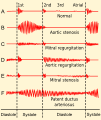 Phonocardiograms from normal and abnormal heart sounds
 -
Mitral valvuloplasty.

See also[edit]
References[edit]

Advertise on WikiMD — 81,000+ full articles, ~900,000 total pages, ~250 million page views. Global reach, limited time promotional rates from $1/page/day. Learn more · View stats

Translate page: - East Asian
中文,
日本,
한국어,
South Asian
हिन्दी,
தமிழ்,
తెలుగు,
Urdu,
ಕನ್ನಡ,
Southeast Asian
Indonesian,
Vietnamese,
Thai,
မြန်မာဘာသာ,
বাংলা
European
español,
Deutsch,
français,
Greek,
português do Brasil,
polski,
română,
русский,
Nederlands,
norsk,
svenska,
suomi,
Italian
Middle Eastern & African
عربى,
Turkish,
Persian,
Hebrew,
Afrikaans,
isiZulu,
Kiswahili,
Other
Bulgarian,
Hungarian,
Czech,
Swedish,
മലയാളം,
मराठी,
ਪੰਜਾਬੀ,
ગુજરાતી,
Portuguese,
Ukrainian
About WikiMD • Contact • Disclaimer • Privacy • Copyright • Site statistics
Some content and images may originate from Wikimedia Commons or Wikipedia and remain subject to their stated licenses. Unless otherwise noted, eligible WikiMD content is available under CC BY-SA 4.0.
WikiMD Wellnesspedia — Free health & wellness information for patients, students, and health professionals.


