Milk punch
Milk Punch is a traditional beverage made from a blend of milk, sugar, and spirits. The drink, which originated in the 17th century, is often associated with the Southern United States and England, where it is typically served during the holiday season or at brunch.
History[edit]
The origins of Milk Punch can be traced back to the 17th century in England. It was popularized by Aphra Behn, a British playwright and novelist, who mentioned the drink in her works. The beverage was later brought to the Southern United States by British colonists, where it became a staple at holiday gatherings and brunches.
Preparation[edit]
Milk Punch is prepared by combining milk, sugar, and a spirit such as bourbon, rum, or brandy. The mixture is then heated until the sugar dissolves. Some variations of the recipe may include additional ingredients such as vanilla extract, nutmeg, or cinnamon for added flavor. The drink is typically served cold, often over ice.
Variations[edit]
There are two main variations of Milk Punch: the clear and the creamy version. The clear version, also known as Clarified Milk Punch, involves curdling the milk with the spirit and then straining the mixture to remove the solids. This results in a clear, smooth drink. The creamy version, on the other hand, does not involve curdling and straining, resulting in a thicker, creamier beverage.
Cultural Significance[edit]
Milk Punch has a significant cultural role in the Southern United States and England. In the South, it is often served during the holiday season, particularly at Christmas and New Year's Day celebrations. In England, it is traditionally consumed at brunches and is often associated with the Boxing Day holiday.
See Also[edit]
 | This drink-related article is a stub. You can help WikiMD by expanding the page. |
-
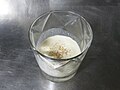 Glass of eggnog
 -
 Clarified milk punches in tasting glasses


Medical Disclaimer: WikiMD is for informational purposes only and is not a substitute for professional medical advice. Content may be inaccurate or outdated and should not be used for diagnosis or treatment. Always consult your healthcare provider for medical decisions. Verify information with trusted sources such as CDC.gov and NIH.gov. By using this site, you agree that WikiMD is not liable for any outcomes related to its content. See full disclaimer.
Credits:Most images are courtesy of Wikimedia commons, and templates, categories Wikipedia, licensed under CC BY SA or similar.
Translate this page: - East Asian
中文,
日本,
한국어,
South Asian
हिन्दी,
தமிழ்,
తెలుగు,
Urdu,
ಕನ್ನಡ,
Southeast Asian
Indonesian,
Vietnamese,
Thai,
မြန်မာဘာသာ,
বাংলা
European
español,
Deutsch,
français,
Greek,
português do Brasil,
polski,
română,
русский,
Nederlands,
norsk,
svenska,
suomi,
Italian
Middle Eastern & African
عربى,
Turkish,
Persian,
Hebrew,
Afrikaans,
isiZulu,
Kiswahili,
Other
Bulgarian,
Hungarian,
Czech,
Swedish,
മലയാളം,
मराठी,
ਪੰਜਾਬੀ,
ગુજરાતી,
Portuguese,
Ukrainian
