Middle cervical ganglion
The Middle Cervical Ganglion (MCG) is a part of the sympathetic nervous system, specifically the sympathetic chain, which is a part of the autonomic nervous system. It is one of the three cervical ganglia, the other two being the superior cervical ganglion and the inferior cervical ganglion.
Anatomy[edit]
The Middle Cervical Ganglion is typically located near the sixth cervical vertebra, although its position can vary. It is the smallest of the three cervical ganglia. It is situated anterior to the vertebral artery and in front of the transverse process of the sixth cervical vertebra, lying on the longus colli muscle.
Function[edit]
The Middle Cervical Ganglion provides sympathetic innervation to the thyroid gland, parathyroid glands, and the heart. It sends postganglionic fibers to the heart via the cardiac plexus, and to the thyroid and parathyroid glands directly or through the ansa cervicalis.
Clinical Significance[edit]
Due to its role in innervating the heart and thyroid gland, damage or dysfunction of the Middle Cervical Ganglion can lead to various clinical conditions. These include cardiac arrhythmias, hyperthyroidism, and hypothyroidism. It may also be involved in certain types of neck pain and headaches.
See Also[edit]
- Sympathetic Nervous System
- Superior Cervical Ganglion
- Inferior Cervical Ganglion
- Cardiac Plexus
- Ansa Cervicalis
References[edit]

 | This article about a neurology is a stub. You can help WikiMD by expanding the page. |
-
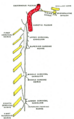 Middle cervical ganglion

Advertise on WikiMD — 81,000+ full articles, ~900,000 total pages, ~250 million page views. Global reach, limited time promotional rates from $1/page/day. Learn more · View stats


Translate page: - East Asian
中文,
日本,
한국어,
South Asian
हिन्दी,
தமிழ்,
తెలుగు,
Urdu,
ಕನ್ನಡ,
Southeast Asian
Indonesian,
Vietnamese,
Thai,
မြန်မာဘာသာ,
বাংলা
European
español,
Deutsch,
français,
Greek,
português do Brasil,
polski,
română,
русский,
Nederlands,
norsk,
svenska,
suomi,
Italian
Middle Eastern & African
عربى,
Turkish,
Persian,
Hebrew,
Afrikaans,
isiZulu,
Kiswahili,
Other
Bulgarian,
Hungarian,
Czech,
Swedish,
മലയാളം,
मराठी,
ਪੰਜਾਬੀ,
ગુજરાતી,
Portuguese,
Ukrainian
About WikiMD • Contact • Disclaimer • Privacy • Copyright • Site statistics
Some content and images may originate from Wikimedia Commons or Wikipedia and remain subject to their stated licenses. Unless otherwise noted, eligible WikiMD content is available under CC BY-SA 4.0.
WikiMD Wellnesspedia — Free health & wellness information for patients, students, and health professionals.

