Melia azedarach
Melia azedarach, commonly known as the chinaberry tree, bead tree, Cape lilac, syringa berrytree, Persian lilac, and Indian lilac, is a species of deciduous tree in the mahogany family, Meliaceae, that is native to Indomalaya and Australasia.
Description[edit]
Melia azedarach is a fast-growing tree that can reach up to 15 meters in height. It has a broad crown and its bark is light grey, with the leaves being dark green and twice pinnate, resembling those of the neem tree. The flowers are small and fragrant, with five pale purple or lilac petals, growing in clusters in spring. The fruit is a drupe, yellow to brown in color, and contains several seeds.
Distribution and habitat[edit]
Melia azedarach is native to Asia and Australia, but has been introduced to other parts of the world including North America, South America, and Africa. It is often found in forests, along riverbanks, and in urban areas where it is used as an ornamental tree.
Uses[edit]
The wood of Melia azedarach is used for making furniture, tool handles, and other items. The tree's fruits are used in traditional medicine, particularly in India and China, where they are believed to have antiviral, antibacterial, and antifungal properties. However, they are toxic if ingested in large quantities.
Cultivation[edit]
Melia azedarach is a hardy tree that can tolerate a range of soil types, but prefers well-drained soil. It is drought-tolerant and can grow in full sun to partial shade. The tree is propagated from seeds, which need to be soaked in water for 24 hours before planting.
Conservation status[edit]
While Melia azedarach is not currently listed as threatened or endangered, it is considered invasive in some regions where it has been introduced, such as the southern United States and parts of South Africa.
See also[edit]

This flora-related article is a stub. You can help WikiMD by expanding it.
-
Melia azedarach 01434
-
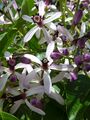 1A-M azedarach 003
 -
Melia azedarach kz02
-
Indian Grey Hornbill eating Bakain berries
-
Egyptian Rousette
-
Melia azedarach00


Medical Disclaimer: WikiMD is for informational purposes only and is not a substitute for professional medical advice. Content may be inaccurate or outdated and should not be used for diagnosis or treatment. Always consult your healthcare provider for medical decisions. Verify information with trusted sources such as CDC.gov and NIH.gov. By using this site, you agree that WikiMD is not liable for any outcomes related to its content. See full disclaimer.
Credits:Most images are courtesy of Wikimedia commons, and templates, categories Wikipedia, licensed under CC BY SA or similar.
Translate page: - East Asian
中文,
日本,
한국어,
South Asian
हिन्दी,
தமிழ்,
తెలుగు,
Urdu,
ಕನ್ನಡ,
Southeast Asian
Indonesian,
Vietnamese,
Thai,
မြန်မာဘာသာ,
বাংলা
European
español,
Deutsch,
français,
Greek,
português do Brasil,
polski,
română,
русский,
Nederlands,
norsk,
svenska,
suomi,
Italian
Middle Eastern & African
عربى,
Turkish,
Persian,
Hebrew,
Afrikaans,
isiZulu,
Kiswahili,
Other
Bulgarian,
Hungarian,
Czech,
Swedish,
മലയാളം,
मराठी,
ਪੰਜਾਬੀ,
ગુજરાતી,
Portuguese,
Ukrainian


_eating_Bakain_(Melia_Azadirachta)_berries_at_Roorkee,_Uttarakhand_W_IMG_9016.jpg)

