Mecoprop
Mecoprop (or MCPP) is a chemical compound used as a selective herbicide. It is a member of the phenoxy herbicide group and is commonly used for the post-emergence control of annual and perennial broadleaf weeds in a variety of crops and environments.
Chemical Structure and Properties[edit]
Mecoprop is a chiral compound, meaning it has two enantiomers, or forms that are mirror images of each other. These enantiomers have different biological activities, with the (R)-enantiomer being more active as a herbicide than the (S)-enantiomer. Mecoprop is often sold as a mixture of both enantiomers.
The chemical formula of mecoprop is C10H11ClO3, and it has a molecular weight of 214.64 g/mol. It is a white crystalline solid at room temperature, with a melting point of 114-116 °C and a boiling point of 210-220 °C.
Uses[edit]
Mecoprop is used to control a wide range of broadleaf weeds, including dandelion, clover, and ground ivy. It is used in both agricultural and non-agricultural settings, including lawns, golf courses, and other turf areas.
Health Effects[edit]
Exposure to mecoprop can cause a variety of health effects, depending on the route and duration of exposure. Short-term exposure can cause skin and eye irritation, while long-term exposure can cause damage to the liver and kidneys. Mecoprop is also a potential endocrine disruptor.
Environmental Impact[edit]
Mecoprop is moderately persistent in the environment, with a half-life in soil of 1-3 weeks. It is highly soluble in water and can leach into groundwater. It is also toxic to some aquatic organisms.
Regulation[edit]
In the European Union, mecoprop is approved for use as a herbicide under certain conditions. In the United States, it is classified as a general use pesticide by the Environmental Protection Agency.
 | This medical article is a stub. You can help WikiMD by expanding the page. |
Mecoprop gallery[edit]
-
 Mecoprop structure
 -
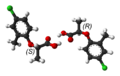 Mecoprop racemic dimer 3D balls
 -
 (±)-Mecoprop Enantiomers Formulae


-Mecoprop_Enantiomers_Formulae.png)

Medical Disclaimer: WikiMD is for informational purposes only and is not a substitute for professional medical advice. Content may be inaccurate or outdated and should not be used for diagnosis or treatment. Always consult your healthcare provider for medical decisions. Verify information with trusted sources such as CDC.gov and NIH.gov. By using this site, you agree that WikiMD is not liable for any outcomes related to its content. See full disclaimer.
Credits:Most images are courtesy of Wikimedia commons, and templates, categories Wikipedia, licensed under CC BY SA or similar.
Translate page: - East Asian
中文,
日本,
한국어,
South Asian
हिन्दी,
தமிழ்,
తెలుగు,
Urdu,
ಕನ್ನಡ,
Southeast Asian
Indonesian,
Vietnamese,
Thai,
မြန်မာဘာသာ,
বাংলা
European
español,
Deutsch,
français,
Greek,
português do Brasil,
polski,
română,
русский,
Nederlands,
norsk,
svenska,
suomi,
Italian
Middle Eastern & African
عربى,
Turkish,
Persian,
Hebrew,
Afrikaans,
isiZulu,
Kiswahili,
Other
Bulgarian,
Hungarian,
Czech,
Swedish,
മലയാളം,
मराठी,
ਪੰਜਾਬੀ,
ગુજરાતી,
Portuguese,
Ukrainian

