Clover
Clover (Trifolium), a genus within the family Fabaceae, is a group of legumes known for their distinctive three-lobed leaves and colorful flowers. The genus is native to the temperate regions of the Northern Hemisphere, with some species also found in Africa and South America. Clovers are important in agriculture as a source of fodder for livestock, for their role in soil fertility through nitrogen fixation, and as a cover crop to prevent soil erosion.
Description[edit]
Clovers are herbaceous, mostly perennial plants, although some species are annuals. They vary in size from small, creeping plants to larger species that can reach up to 80 cm in height. The leaves are typically trifoliate, composed of three leaflets, but in some species, the leaves may be compounded further. The flowers, borne in dense inflorescences, range in color from white to pink, red, or purple, and are highly attractive to bees and other pollinators.
Ecology[edit]
Clovers play a significant role in their ecosystems. As members of the legume family, they are capable of nitrogen fixation, a process by which atmospheric nitrogen is converted into a form that is usable by plants. This ability allows clovers to thrive in nutrient-poor soils and enhances soil fertility, benefiting other plants in the vicinity. Furthermore, clovers are a key food source for various pollinators, including bees, which rely on their nectar and pollen.
Agricultural Uses[edit]
In agriculture, clovers are valued for several reasons. They are widely used as fodder crops, providing a nutritious food source for livestock. Clovers are also planted as cover crops to improve soil structure, enhance soil fertility through nitrogen fixation, and suppress weeds. Additionally, clovers can be used in crop rotation systems to break cycles of pests and diseases.
Species[edit]
There are over 300 species of clover, with the most well-known being the Red Clover (Trifolium pratense), White Clover (Trifolium repens), and Crimson Clover (Trifolium incarnatum). Each species has its own specific requirements and benefits, making them suitable for different environments and agricultural practices.
Cultural Significance[edit]
Clovers, especially the four-leafed varieties, are often considered symbols of good luck. The rarity of the four-leaf clover has made it a popular symbol in various cultures, associated with fortune and prosperity.
Conservation[edit]
While many clover species are common and not considered at risk, habitat destruction and agricultural intensification pose threats to some native species. Conservation efforts focus on preserving natural habitats and promoting sustainable agricultural practices that support biodiversity.
See Also[edit]

-
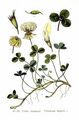 White clover (Trifolium repens)
 -
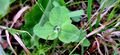 A drop of dew on a clover
 -
Clovers and Zrebar
-
Lesser trefoil (Trifolium dubium)
-
Alpine clover (Trifolium alpestre)
-
 Clover
 -
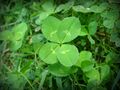 Four-leaf clover
 -
Five-leaf clover


Medical Disclaimer: WikiMD is for informational purposes only and is not a substitute for professional medical advice. Content may be inaccurate or outdated and should not be used for diagnosis or treatment. Always consult your healthcare provider for medical decisions. Verify information with trusted sources such as CDC.gov and NIH.gov. By using this site, you agree that WikiMD is not liable for any outcomes related to its content. See full disclaimer.
Credits:Most images are courtesy of Wikimedia commons, and templates, categories Wikipedia, licensed under CC BY SA or similar.
Translate page: - East Asian
中文,
日本,
한국어,
South Asian
हिन्दी,
தமிழ்,
తెలుగు,
Urdu,
ಕನ್ನಡ,
Southeast Asian
Indonesian,
Vietnamese,
Thai,
မြန်မာဘာသာ,
বাংলা
European
español,
Deutsch,
français,
Greek,
português do Brasil,
polski,
română,
русский,
Nederlands,
norsk,
svenska,
suomi,
Italian
Middle Eastern & African
عربى,
Turkish,
Persian,
Hebrew,
Afrikaans,
isiZulu,
Kiswahili,
Other
Bulgarian,
Hungarian,
Czech,
Swedish,
മലയാളം,
मराठी,
ਪੰਜਾਬੀ,
ગુજરાતી,
Portuguese,
Ukrainian


