Mallory–Weiss syndrome

Editor-In-Chief: Prab R Tumpati, MD
Obesity, Sleep & Internal medicine
Founder, WikiMD Wellnesspedia &
W8MD's weight loss doctor NYC
Philadelphia GLP-1 weight loss and GLP-1 clinic NYC
| Mallory–Weiss syndrome | |
|---|---|
 | |
| Synonyms | N/A |
| Pronounce | N/A |
| Specialty | N/A |
| Symptoms | Hematemesis, melena, abdominal pain |
| Complications | Hypovolemic shock, anemia |
| Onset | Sudden |
| Duration | Usually self-limiting |
| Types | N/A |
| Causes | Severe vomiting, retching, coughing |
| Risks | Alcoholism, hiatal hernia, bulimia nervosa |
| Diagnosis | Endoscopy |
| Differential diagnosis | Peptic ulcer disease, esophageal varices, gastritis |
| Prevention | Avoidance of risk factors |
| Treatment | Supportive care, endoscopic hemostasis |
| Medication | Proton pump inhibitors, antiemetics |
| Prognosis | Generally good with treatment |
| Frequency | 4-8 per 100,000 per year |
| Deaths | N/A |
A condition characterized by tears in the mucous membrane of the esophagus
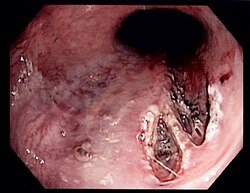
Mallory–Weiss syndrome is a medical condition characterized by tears in the mucous membrane of the esophagus, where it meets the stomach. These tears can lead to bleeding and are often associated with severe vomiting, retching, or coughing.
Pathophysiology[edit]
The tears in Mallory–Weiss syndrome occur at the gastroesophageal junction, which is the area where the esophagus connects to the stomach. The condition is typically caused by a sudden increase in intra-abdominal pressure, which can occur during episodes of forceful vomiting or retching. This pressure can cause the mucosal lining to tear, leading to bleeding.
Causes[edit]
Mallory–Weiss syndrome is most commonly associated with:
- Severe or prolonged vomiting
- Retching
- Coughing
- Hiatal hernia
- Alcoholism
- Bulimia nervosa
Symptoms[edit]
The primary symptom of Mallory–Weiss syndrome is hematemesis, which is the vomiting of blood. Other symptoms may include:
- Melena (black, tarry stools)
- Abdominal pain
- Dizziness or syncope due to blood loss
Diagnosis[edit]
Diagnosis of Mallory–Weiss syndrome is typically made through endoscopy, which allows direct visualization of the tears in the esophagus. During an endoscopy, a flexible tube with a camera is inserted through the mouth into the esophagus and stomach.
Treatment[edit]
Treatment for Mallory–Weiss syndrome focuses on stopping the bleeding and addressing the underlying cause. Options may include:
- Endoscopic therapy, such as cauterization or band ligation
- Intravenous fluids to maintain hydration
- Blood transfusions if significant blood loss has occurred
- Medications to reduce stomach acid and prevent further irritation
Prognosis[edit]
The prognosis for Mallory–Weiss syndrome is generally good, especially if the condition is promptly diagnosed and treated. Most tears heal without intervention, but severe cases may require more aggressive treatment.
Prevention[edit]
Preventive measures for Mallory–Weiss syndrome include:
- Avoiding excessive alcohol consumption
- Managing conditions that cause vomiting or retching
- Treating underlying gastroesophageal reflux disease (GERD)
See also[edit]

Medical Disclaimer: WikiMD is for informational purposes only and is not a substitute for professional medical advice. Content may be inaccurate or outdated and should not be used for diagnosis or treatment. Always consult your healthcare provider for medical decisions. Verify information with trusted sources such as CDC.gov and NIH.gov. By using this site, you agree that WikiMD is not liable for any outcomes related to its content. See full disclaimer.
Credits:Most images are courtesy of Wikimedia commons, and templates, categories Wikipedia, licensed under CC BY SA or similar.
Translate page: - East Asian
中文,
日本,
한국어,
South Asian
हिन्दी,
தமிழ்,
తెలుగు,
Urdu,
ಕನ್ನಡ,
Southeast Asian
Indonesian,
Vietnamese,
Thai,
မြန်မာဘာသာ,
বাংলা
European
español,
Deutsch,
français,
Greek,
português do Brasil,
polski,
română,
русский,
Nederlands,
norsk,
svenska,
suomi,
Italian
Middle Eastern & African
عربى,
Turkish,
Persian,
Hebrew,
Afrikaans,
isiZulu,
Kiswahili,
Other
Bulgarian,
Hungarian,
Czech,
Swedish,
മലയാളം,
मराठी,
ਪੰਜਾਬੀ,
ગુજરાતી,
Portuguese,
Ukrainian

