Linea alba (abdomen)

Fibrous structure that runs down the midline of the abdomen
[[File: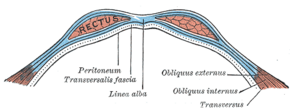 |frameless|alt=]]

| Details | |
|---|---|
| Synonyms | |
| Pronunciation | |
| Carnegie stage | |
| Days | |
| Precursor | |
| Gives rise to | |
| Part of | Abdomen |
The linea alba (Latin for "white line") is a fibrous structure that runs down the midline of the abdomen in humans and other vertebrates. It is formed by the fusion of the aponeuroses of the abdominal muscles and extends from the xiphoid process of the sternum to the pubic symphysis.
Structure[edit]
The linea alba is composed primarily of collagen connective tissue. It is formed by the interlacing of the aponeuroses of the external oblique, internal oblique, and transversus abdominis muscles. This structure provides a central attachment point for these muscles, contributing to the integrity and strength of the anterior abdominal wall.
Function[edit]
The primary function of the linea alba is to maintain the alignment and integrity of the abdominal muscles. It acts as a central tendon for the rectus abdominis muscles, allowing for the efficient transmission of force across the midline of the body. This is particularly important during activities that involve bending, twisting, and other movements of the torso.
Clinical significance[edit]
The linea alba is a common site for surgical incisions, particularly in procedures involving the abdomen. Its relatively avascular nature reduces the risk of bleeding during surgery. However, it is also a site where hernias, such as epigastric hernias, can occur due to weaknesses in the connective tissue.
Related structures[edit]
- Linea nigra: A dark vertical line that appears on the abdomen during pregnancy, which is a hyperpigmented form of the linea alba.
- Rectus sheath: The fibrous sheath formed by the aponeuroses of the abdominal muscles, which encloses the rectus abdominis muscles and contributes to the formation of the linea alba.
See also[edit]
References[edit]


Medical Disclaimer: WikiMD is for informational purposes only and is not a substitute for professional medical advice. Content may be inaccurate or outdated and should not be used for diagnosis or treatment. Always consult your healthcare provider for medical decisions. Verify information with trusted sources such as CDC.gov and NIH.gov. By using this site, you agree that WikiMD is not liable for any outcomes related to its content. See full disclaimer.
Credits:Most images are courtesy of Wikimedia commons, and templates, categories Wikipedia, licensed under CC BY SA or similar.
Translate page: - East Asian
中文,
日本,
한국어,
South Asian
हिन्दी,
தமிழ்,
తెలుగు,
Urdu,
ಕನ್ನಡ,
Southeast Asian
Indonesian,
Vietnamese,
Thai,
မြန်မာဘာသာ,
বাংলা
European
español,
Deutsch,
français,
Greek,
português do Brasil,
polski,
română,
русский,
Nederlands,
norsk,
svenska,
suomi,
Italian
Middle Eastern & African
عربى,
Turkish,
Persian,
Hebrew,
Afrikaans,
isiZulu,
Kiswahili,
Other
Bulgarian,
Hungarian,
Czech,
Swedish,
മലയാളം,
मराठी,
ਪੰਜਾਬੀ,
ગુજરાતી,
Portuguese,
Ukrainian

