Abdominal wall
Anatomical structure enclosing the abdominal cavity
The abdominal wall is a complex structure that forms the boundary of the abdominal cavity. It plays a crucial role in maintaining the integrity of the abdominal contents and is involved in various physiological functions such as respiration, posture, and movement.
Anatomy[edit]
The abdominal wall is composed of several layers, including skin, fascia, muscles, and peritoneum. These layers work together to provide strength and flexibility.
Layers[edit]
- Skin: The outermost layer, which provides protection and sensation.
- Superficial fascia: A layer of connective tissue that contains fat and provides insulation and padding.
- Muscles: The muscular layer includes several important muscles:
 * Rectus abdominis
 * External oblique
 * Internal oblique
 * Transversus abdominis
- Deep fascia: A dense layer of connective tissue that surrounds the muscles.
- Peritoneum: The innermost layer, a serous membrane that lines the abdominal cavity.
Muscles[edit]
The muscles of the abdominal wall are crucial for various functions, including:
- Support: Providing structural support to the abdominal organs.
- Movement: Facilitating movements such as bending and twisting.
- Respiration: Assisting in breathing by changing the volume of the thoracic cavity.
- Intra-abdominal pressure: Helping in functions like defecation and childbirth by increasing pressure within the abdominal cavity.
Functions[edit]
The abdominal wall serves several important functions:
- Protection: Shields the internal organs from external injury.
- Support: Maintains the position of abdominal organs.
- Movement: Allows for flexion, extension, and rotation of the trunk.
- Respiration: Assists in the mechanics of breathing.
- Pressure regulation: Helps in maintaining intra-abdominal pressure for various physiological processes.
Clinical significance[edit]
The abdominal wall is subject to various medical conditions, including:
- Hernias: Protrusions of abdominal contents through a weak spot in the wall.
- Trauma: Injuries that can affect the integrity of the wall.
- Infections: Such as abscesses or cellulitis.
Related pages[edit]
Gallery[edit]
-
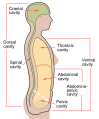 Diagram of body cavities
 -
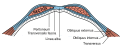 Muscles of the abdominal wall


Medical Disclaimer: WikiMD is for informational purposes only and is not a substitute for professional medical advice. Content may be inaccurate or outdated and should not be used for diagnosis or treatment. Always consult your healthcare provider for medical decisions. Verify information with trusted sources such as CDC.gov and NIH.gov. By using this site, you agree that WikiMD is not liable for any outcomes related to its content. See full disclaimer.
Credits:Most images are courtesy of Wikimedia commons, and templates, categories Wikipedia, licensed under CC BY SA or similar.
Translate page: - East Asian
中文,
日本,
한국어,
South Asian
हिन्दी,
தமிழ்,
తెలుగు,
Urdu,
ಕನ್ನಡ,
Southeast Asian
Indonesian,
Vietnamese,
Thai,
မြန်မာဘာသာ,
বাংলা
European
español,
Deutsch,
français,
Greek,
português do Brasil,
polski,
română,
русский,
Nederlands,
norsk,
svenska,
suomi,
Italian
Middle Eastern & African
عربى,
Turkish,
Persian,
Hebrew,
Afrikaans,
isiZulu,
Kiswahili,
Other
Bulgarian,
Hungarian,
Czech,
Swedish,
മലയാളം,
मराठी,
ਪੰਜਾਬੀ,
ગુજરાતી,
Portuguese,
Ukrainian

