Fruit curd
Fruit curd is a dessert spread and topping usually made with citrus fruit, such as lemon, lime, orange, or tangerine. Other flavor variations include passion fruit, mango, and berries such as raspberries, cranberries or blackberries. The basic ingredients are beaten egg yolks, sugar, fruit juice and zest which are gently cooked together until thick and then allowed to cool, forming a soft, smooth, intensely flavored spread.
History[edit]
The precise origins of fruit curd are unclear, but it is believed to have been first made in England during the 19th century. The earliest recorded recipes for lemon curd were found in English cookbooks dating back to the early 1800s. The term "curd" in this context refers to the process of curdling, as the cooking of the lemon juice, egg yolks and sugar results in a creamy, thick spread that has a texture similar to that of custard.
Preparation[edit]
The preparation of fruit curd involves the gentle cooking of a mixture of fruit juice (and sometimes zest), sugar, butter and egg yolks. The mixture is typically cooked in a double boiler (or a heatproof bowl over simmering water) until it thickens. The resulting curd is then strained to remove any solids and left to cool. The high proportion of egg yolks in the mixture gives fruit curd its rich, creamy texture.
Uses[edit]
Fruit curd is often used as a spread for scones, muffins, or toast. It can also be used as a filling for desserts such as tarts, pies, and cakes. Lemon curd, in particular, is a traditional ingredient in Lemon meringue pie.
Variations[edit]
While lemon curd is the most common type, many other variations exist. Lime curd, orange curd, and tangerine curd are all popular citrus-based variations. Other fruits, such as passion fruit, mango, and various berries, can also be used to make fruit curd.
See also[edit]

-
 Lemon curd in a jar
 -
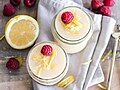 Vegan lemon curd
 -
 Orange curd in a bowl

.jpg)

Ad. Transform your life with W8MD's
GLP-1 weight loss injections special from $29.99 with insurance
|
WikiMD Medical Encyclopedia |
Medical Disclaimer: WikiMD is for informational purposes only and is not a substitute for professional medical advice. Content may be inaccurate or outdated and should not be used for diagnosis or treatment. Always consult your healthcare provider for medical decisions. Verify information with trusted sources such as CDC.gov and NIH.gov. By using this site, you agree that WikiMD is not liable for any outcomes related to its content. See full disclaimer.
Credits:Most images are courtesy of Wikimedia commons, and templates, categories Wikipedia, licensed under CC BY SA or similar.
Translate this page: - East Asian
中文,
日本,
한국어,
South Asian
हिन्दी,
தமிழ்,
తెలుగు,
Urdu,
ಕನ್ನಡ,
Southeast Asian
Indonesian,
Vietnamese,
Thai,
မြန်မာဘာသာ,
বাংলা
European
español,
Deutsch,
français,
Greek,
português do Brasil,
polski,
română,
русский,
Nederlands,
norsk,
svenska,
suomi,
Italian
Middle Eastern & African
عربى,
Turkish,
Persian,
Hebrew,
Afrikaans,
isiZulu,
Kiswahili,
Other
Bulgarian,
Hungarian,
Czech,
Swedish,
മലയാളം,
मराठी,
ਪੰਜਾਬੀ,
ગુજરાતી,
Portuguese,
Ukrainian
