Laryngeal artery

The laryngeal artery refers to the arteries that supply blood to the larynx. There are two main laryngeal arteries: the superior thyroid artery and the inferior thyroid artery.
Superior Laryngeal Artery[edit]
The superior laryngeal artery is a branch of the superior thyroid artery. It accompanies the internal laryngeal nerve and supplies the larynx above the vocal cords.
Inferior Laryngeal Artery[edit]
The inferior laryngeal artery is a branch of the inferior thyroid artery. It accompanies the recurrent laryngeal nerve and supplies the larynx below the vocal cords.
Function[edit]
The laryngeal arteries are crucial for providing oxygenated blood to the larynx, which is essential for its function in voice production and breathing.
Clinical Significance[edit]
Damage to the laryngeal arteries can lead to ischemia of the laryngeal tissues, potentially affecting voice and airway function. Surgical procedures involving the thyroid gland or the neck must take care to preserve these arteries to prevent complications.
Gallery[edit]
-
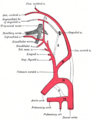 Diagram showing the origins of the main branches of the carotid arteries.
 -
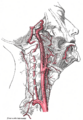 The internal carotid and vertebral arteries. Right side. (Superior thyroid visible at center.)
 -
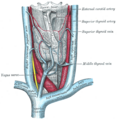 The thyroid gland and its relations.
 -
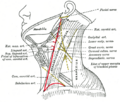 Side of neck, showing chief surface markings.
 -
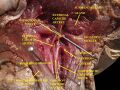 Muscles, arteries and nerves of neck.Newborn dissection.
 -
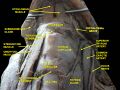 Muscles, nerves and arteries of neck.Deep dissection. Anterior view.


See Also[edit]
| Arteries of the head and neck | ||||||||||||||||||||||||||||||||
|---|---|---|---|---|---|---|---|---|---|---|---|---|---|---|---|---|---|---|---|---|---|---|---|---|---|---|---|---|---|---|---|---|
|

Medical Disclaimer: WikiMD is for informational purposes only and is not a substitute for professional medical advice. Content may be inaccurate or outdated and should not be used for diagnosis or treatment. Always consult your healthcare provider for medical decisions. Verify information with trusted sources such as CDC.gov and NIH.gov. By using this site, you agree that WikiMD is not liable for any outcomes related to its content. See full disclaimer.
Credits:Most images are courtesy of Wikimedia commons, and templates, categories Wikipedia, licensed under CC BY SA or similar.
Translate page: - East Asian
中文,
日本,
한국어,
South Asian
हिन्दी,
தமிழ்,
తెలుగు,
Urdu,
ಕನ್ನಡ,
Southeast Asian
Indonesian,
Vietnamese,
Thai,
မြန်မာဘာသာ,
বাংলা
European
español,
Deutsch,
français,
Greek,
português do Brasil,
polski,
română,
русский,
Nederlands,
norsk,
svenska,
suomi,
Italian
Middle Eastern & African
عربى,
Turkish,
Persian,
Hebrew,
Afrikaans,
isiZulu,
Kiswahili,
Other
Bulgarian,
Hungarian,
Czech,
Swedish,
മലയാളം,
मराठी,
ਪੰਜਾਬੀ,
ગુજરાતી,
Portuguese,
Ukrainian


