Ciliary arteries
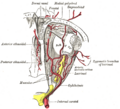
Ciliary arteries are a group of arteries that supply the eye and its surrounding structures. They are branches of the ophthalmic artery, which is a major branch of the internal carotid artery. The ciliary arteries are divided into three groups: the short posterior ciliary arteries, the long posterior ciliary arteries, and the anterior ciliary arteries.
Etymology[edit]
The term "ciliary" comes from the Latin word "cilia," which means "eyelash." This is likely due to the resemblance of these arteries to eyelashes in their arrangement around the eye.
Short posterior ciliary arteries[edit]
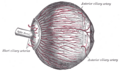
The short posterior ciliary arteries are a group of about 20 small arteries that arise from the ophthalmic artery. They pass forward around the optic nerve to the posterior part of the eyeball. They supply the choroid and ciliary body, and some branches reach the iris.
Long posterior ciliary arteries[edit]
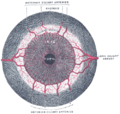
The long posterior ciliary arteries consist of two arteries that arise from the ophthalmic artery. They run forward between the sclera and the choroid to the ciliary body, where they divide into two branches. These branches form an arterial circle, the circulus arteriosus major, with the anterior ciliary arteries. The long posterior ciliary arteries supply the ciliary body, the iris, and the outer layers of the retina.
Anterior ciliary arteries[edit]
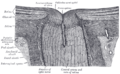
The anterior ciliary arteries are derived from the muscular branches of the ophthalmic artery. They run forward in the substance of the recti muscles to the front of the eyeball. There, they pierce the sclera a short distance from the cornea and end in the circulus arteriosus major. The anterior ciliary arteries supply the anterior part of the uvea, including the ciliary body and the iris.
Related terms[edit]
See also[edit]

This WikiMD article can only be edited by registered and verified editors. You can log in or register.
-
 Ciliary arteries
 -
 Ciliary arteries
 -
 Ciliary arteries
 -
 Ciliary arteries


Medical Disclaimer: WikiMD is for informational purposes only and is not a substitute for professional medical advice. Content may be inaccurate or outdated and should not be used for diagnosis or treatment. Always consult your healthcare provider for medical decisions. Verify information with trusted sources such as CDC.gov and NIH.gov. By using this site, you agree that WikiMD is not liable for any outcomes related to its content. See full disclaimer.
Credits:Most images are courtesy of Wikimedia commons, and templates, categories Wikipedia, licensed under CC BY SA or similar.
Translate page: - East Asian
中文,
日本,
한국어,
South Asian
हिन्दी,
தமிழ்,
తెలుగు,
Urdu,
ಕನ್ನಡ,
Southeast Asian
Indonesian,
Vietnamese,
Thai,
မြန်မာဘာသာ,
বাংলা
European
español,
Deutsch,
français,
Greek,
português do Brasil,
polski,
română,
русский,
Nederlands,
norsk,
svenska,
suomi,
Italian
Middle Eastern & African
عربى,
Turkish,
Persian,
Hebrew,
Afrikaans,
isiZulu,
Kiswahili,
Other
Bulgarian,
Hungarian,
Czech,
Swedish,
മലയാളം,
मराठी,
ਪੰਜਾਬੀ,
ગુજરાતી,
Portuguese,
Ukrainian

