Jujeh kabab
Jujeh kabab is a popular Iranian dish, traditionally made with chicken that has been marinated in lemon juice, onion, saffron, and olive oil, then grilled over a fire. It is often served with basmati rice or wrapped in a flatbread. The dish is also common in Iraqi and Azerbaijani cuisines.
History[edit]
The origins of Jujeh kabab can be traced back to the Persian Empire, where meat and poultry were often grilled on skewers over an open fire. This method of cooking was not only efficient, but also allowed for a unique flavor profile that is still appreciated today.
Preparation[edit]
The preparation of Jujeh kabab begins with the marination of the chicken. The chicken is typically cut into pieces and then marinated in a mixture of lemon juice, chopped onions, saffron, and olive oil. This mixture not only flavors the chicken, but also helps to tenderize it. After marinating for several hours, the chicken pieces are threaded onto skewers and grilled over a fire. The result is a flavorful, juicy kabab that is often served with basmati rice or wrapped in a flatbread.
Variations[edit]
There are several variations of Jujeh kabab in different regions. In Iraq, for example, the dish is often made with a tomato-based marinade and served with a side of pickles. In Azerbaijan, the kabab is typically served with a side of fresh herbs and yogurt.
Cultural Significance[edit]
Jujeh kabab is not only a popular dish in Iran, Iraq, and Azerbaijan, but also has significant cultural importance. It is often served at celebrations and gatherings, and is a staple dish during the Persian New Year.

-
 Jujeh kabab in Isfahan
 -
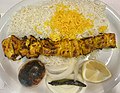 Jujeh kabab in Los Angeles

_Chicken_kabob.jpg)

Medical Disclaimer: WikiMD is for informational purposes only and is not a substitute for professional medical advice. Content may be inaccurate or outdated and should not be used for diagnosis or treatment. Always consult your healthcare provider for medical decisions. Verify information with trusted sources such as CDC.gov and NIH.gov. By using this site, you agree that WikiMD is not liable for any outcomes related to its content. See full disclaimer.
Credits:Most images are courtesy of Wikimedia commons, and templates, categories Wikipedia, licensed under CC BY SA or similar.
Translate page: - East Asian
中文,
日本,
한국어,
South Asian
हिन्दी,
தமிழ்,
తెలుగు,
Urdu,
ಕನ್ನಡ,
Southeast Asian
Indonesian,
Vietnamese,
Thai,
မြန်မာဘာသာ,
বাংলা
European
español,
Deutsch,
français,
Greek,
português do Brasil,
polski,
română,
русский,
Nederlands,
norsk,
svenska,
suomi,
Italian
Middle Eastern & African
عربى,
Turkish,
Persian,
Hebrew,
Afrikaans,
isiZulu,
Kiswahili,
Other
Bulgarian,
Hungarian,
Czech,
Swedish,
മലയാളം,
मराठी,
ਪੰਜਾਬੀ,
ગુજરાતી,
Portuguese,
Ukrainian

