Honey badger
Homolytic cleavage is a type of chemical reaction where the bond between two atoms is broken in such a way that each atom retains one of the two electrons that comprised the bond. This process results in the formation of two free radicals, which are highly reactive due to the presence of an unpaired electron.
Mechanism[edit]
In homolytic cleavage, the bond between two atoms is broken evenly. This is in contrast to heterolytic cleavage, where one atom retains both electrons from the bond. The energy required to break a bond through homolytic cleavage is known as the bond dissociation energy.
The process of homolytic cleavage can be represented using a fish-hook arrow, which indicates the movement of a single electron. This is different from the regular arrow used in chemical reactions, which represents the movement of an electron pair.
Applications[edit]
Homolytic cleavage is a fundamental process in many chemical reactions, particularly in organic chemistry. It is involved in various types of reactions, including combustion reactions, free radical reactions, and polymerization.
In medicine, homolytic cleavage is a key process in the action of certain drugs and toxins. For example, the anticancer drug doxorubicin works by causing homolytic cleavage of DNA strands, thereby inhibiting the replication of cancer cells.
See also[edit]
References[edit]

 | This medical article is a stub. You can help WikiMD by expanding the page. |
-
 Cape Ratel
 -
 Indian Ratel
 -
 Vellivora cottoni
 -
 Ratel Teeth
 -
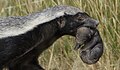 Honey badger carrying young pup
 -
 Indian Honey Badger Drinking Water


.jpg)

Medical Disclaimer: WikiMD is for informational purposes only and is not a substitute for professional medical advice. Content may be inaccurate or outdated and should not be used for diagnosis or treatment. Always consult your healthcare provider for medical decisions. Verify information with trusted sources such as CDC.gov and NIH.gov. By using this site, you agree that WikiMD is not liable for any outcomes related to its content. See full disclaimer.
Credits:Most images are courtesy of Wikimedia commons, and templates, categories Wikipedia, licensed under CC BY SA or similar.
Translate this page: - East Asian
中文,
日本,
한국어,
South Asian
हिन्दी,
தமிழ்,
తెలుగు,
Urdu,
ಕನ್ನಡ,
Southeast Asian
Indonesian,
Vietnamese,
Thai,
မြန်မာဘာသာ,
বাংলা
European
español,
Deutsch,
français,
Greek,
português do Brasil,
polski,
română,
русский,
Nederlands,
norsk,
svenska,
suomi,
Italian
Middle Eastern & African
عربى,
Turkish,
Persian,
Hebrew,
Afrikaans,
isiZulu,
Kiswahili,
Other
Bulgarian,
Hungarian,
Czech,
Swedish,
മലയാളം,
मराठी,
ਪੰਜਾਬੀ,
ગુજરાતી,
Portuguese,
Ukrainian
