Hausa people
Hausa people are an ethnic group predominantly found in the Sahel and Sudanian savanna regions of Sub-Saharan Africa, particularly in the northern half of Nigeria and the southern half of Niger, with significant populations also living in parts of Cameroon, Côte d'Ivoire, Chad, Togo, Ghana, Sudan, Gabon and Senegal.
History[edit]
The history of the Hausa people dates back to the first millennium AD, when they migrated from the east and settled in the region that is now northern Nigeria and southern Niger. The Hausa developed a number of city-states, each with its own monarch known as a Sarki, who was both a political and religious leader. These city-states included Kano, Katsina, Zaria, Gobir, and others.
Culture[edit]
The Hausa culture is rich and diverse, influenced by its long history and the different peoples with whom the Hausa have come into contact. The Hausa are predominantly Muslim, and their society is organized around Islamic institutions, including mosques, Islamic schools, and courts that apply Islamic law. The Hausa language, also called Hausa, is a Chadic language spoken by over 40 million people, making it one of the most widely spoken languages in Africa.
Economy[edit]
The Hausa people are traditionally subsistence farmers, growing crops such as millet, sorghum, and cowpea, and raising livestock including cattle, sheep, and goats. Many Hausa are also involved in long-distance trade, and Hausa traders can be found throughout West Africa and beyond.
Cuisine[edit]
Hausa cuisine is based on grains, especially millet, sorghum, and rice, which are ground into flour and used to make a variety of dishes. These include tuwo, a type of dumpling, and fura, a fermented milk and grain mixture. Meat and vegetables are also important components of the Hausa diet.
See also[edit]
| Ethnic Groups in Africa | ||||||||||
|---|---|---|---|---|---|---|---|---|---|---|
This ethnic groups in Africa related article is a stub.
|
| Niger |
|---|
|
|

-
 Flag of the Hausa people
 -
 Courtyard of Sultan's palace, Zinder, 1906
 -
 The gateway to the Sahara, 1909
 -
 Gobir man
 -
 Sokoto Caliphate
 -
 Hausa Horseman wearing cotton padded armour
 -
 Hausa drummers
 -
 Garaya
 -
 Hausa harpist
 -
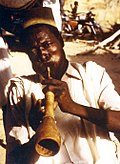 An algaita player, fulbeized Kapsiki


_(14784872245).jpg)


Medical Disclaimer: WikiMD is for informational purposes only and is not a substitute for professional medical advice. Content may be inaccurate or outdated and should not be used for diagnosis or treatment. Always consult your healthcare provider for medical decisions. Verify information with trusted sources such as CDC.gov and NIH.gov. By using this site, you agree that WikiMD is not liable for any outcomes related to its content. See full disclaimer.
Credits:Most images are courtesy of Wikimedia commons, and templates, categories Wikipedia, licensed under CC BY SA or similar.
Translate page: - East Asian
中文,
日本,
한국어,
South Asian
हिन्दी,
தமிழ்,
తెలుగు,
Urdu,
ಕನ್ನಡ,
Southeast Asian
Indonesian,
Vietnamese,
Thai,
မြန်မာဘာသာ,
বাংলা
European
español,
Deutsch,
français,
Greek,
português do Brasil,
polski,
română,
русский,
Nederlands,
norsk,
svenska,
suomi,
Italian
Middle Eastern & African
عربى,
Turkish,
Persian,
Hebrew,
Afrikaans,
isiZulu,
Kiswahili,
Other
Bulgarian,
Hungarian,
Czech,
Swedish,
മലയാളം,
मराठी,
ਪੰਜਾਬੀ,
ગુજરાતી,
Portuguese,
Ukrainian

